
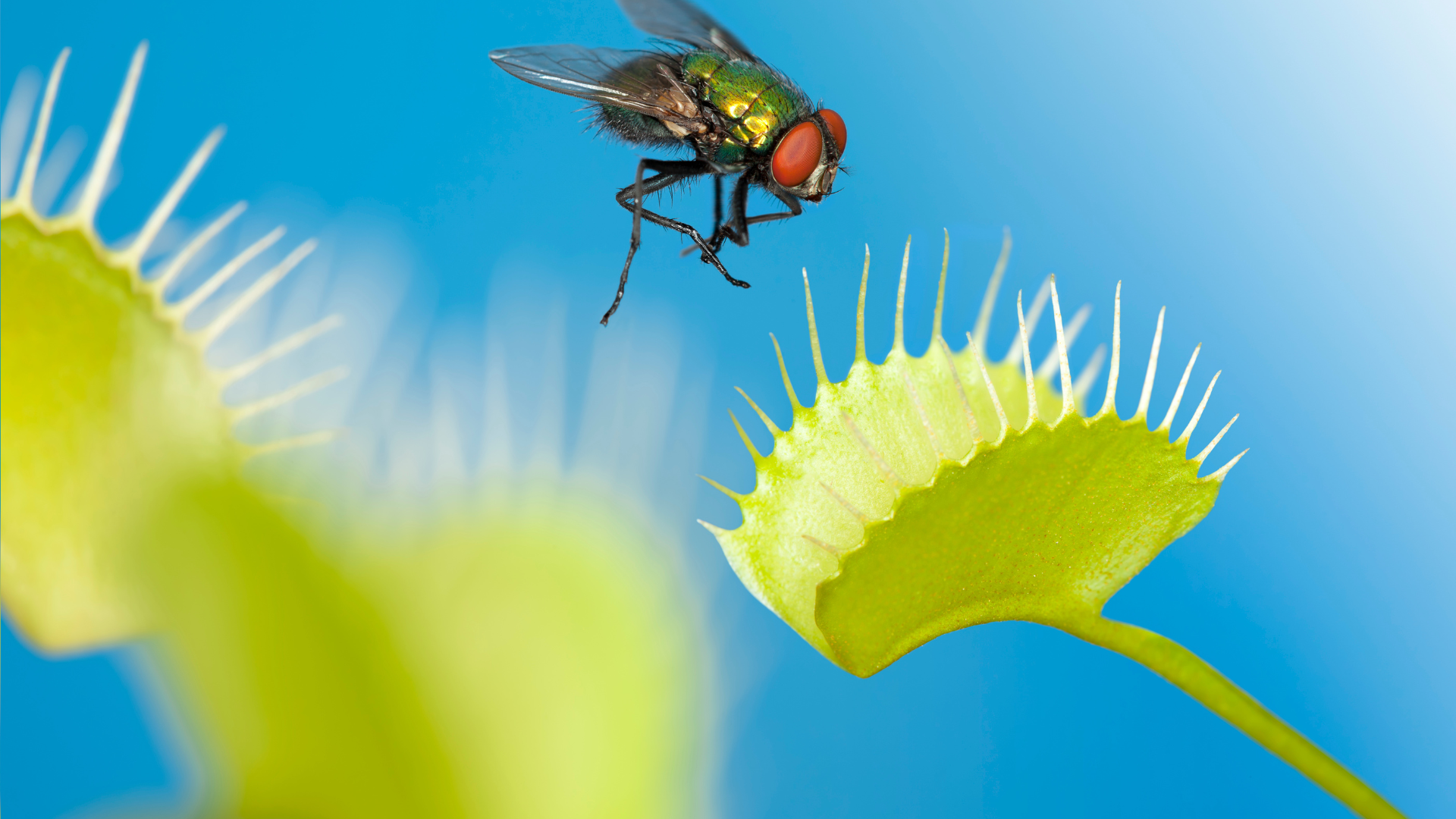
When green turns carnivore
We think of plants as sun powered pacifists rooted, quiet, busy turning light into life. But there is a bolder script in nature: plants that hunt. In bogs, jungles, and shallow lakes, they lure, trap, and digest prey to survive where soils are too poor to feed them. No teeth, no muscles, no brain – yet the efficiency of a cat. That paradox is why plants that hunt fascinate biologists and storytellers alike.
How the idea took root
The modern story starts with Charles Darwin. In 1875 he published Insectivorous Plants, arguing-carefully, experimentally – that some plants capture and digest animals to compensate for nutrient – poor habitats. He dripped albumin on leaves, timed movements, and measured digestion. His verdict: carnivory in plants is not a curiosity; it’s an adaptation.
Why carnivory evolves at all
Across the world, peat bogs and sandy swamps offer sun in abundance but starve roots of nitrogen, phosphorus, and minerals. The evolutionary answer was audacious: build leaves that double as traps, secrete enzymes (or recruit microbes), and mine nutrients from prey. Light supplies energy; victims supply building blocks.
Five ways to catch a meal
Carnivorous plants reinvent the mousetrap again and again:
- Snap traps (active) – Dionaea muscipula (Venus flytrap). Two lobes hinge shut when sensory hairs are touched twice within a short window. The “double-tap” avoids wasting energy on raindrops or debris. Electrical signals ripple through the leaf; the trap tightens and digestion begins.
- Suction traps (ultrafast) – Utricularia (bladderworts). Tiny underwater bladders pump water out to create vacuum. When a trigger hair is nudged, the door pops open and water rushes in, sucking in prey in a few milliseconds. It is among the fastest movements in the plant kingdom.
- Pitfall traps (passive) – Nepenthes (tropical pitcher plants) and Sarracenia (North American pitchers). Waxy rims, nectar lures, and downward-pointing hairs guide victims into a pool of digestive fluid. The trap is the leaf; the vat is the stomach.
- Flypaper traps (sticky) – Drosera (sundews) and Pinguicula (butterworts). Glistening mucilage beads look like dew. In sundews, tentacles slowly curl the whole leaf around the prey, pressing it into enzymes.
- Lobster-pot / eel traps (guiding inward) – Genlisea (corkscrew plants). Subterranean, spiraling leaves channel micro-organisms down one-way passages toward digestion chambers.
Different architectures, same result: convert animal protein into plant nutrition.
A closer look at the icons
Venus flytrap: the counter that won’t be fooled
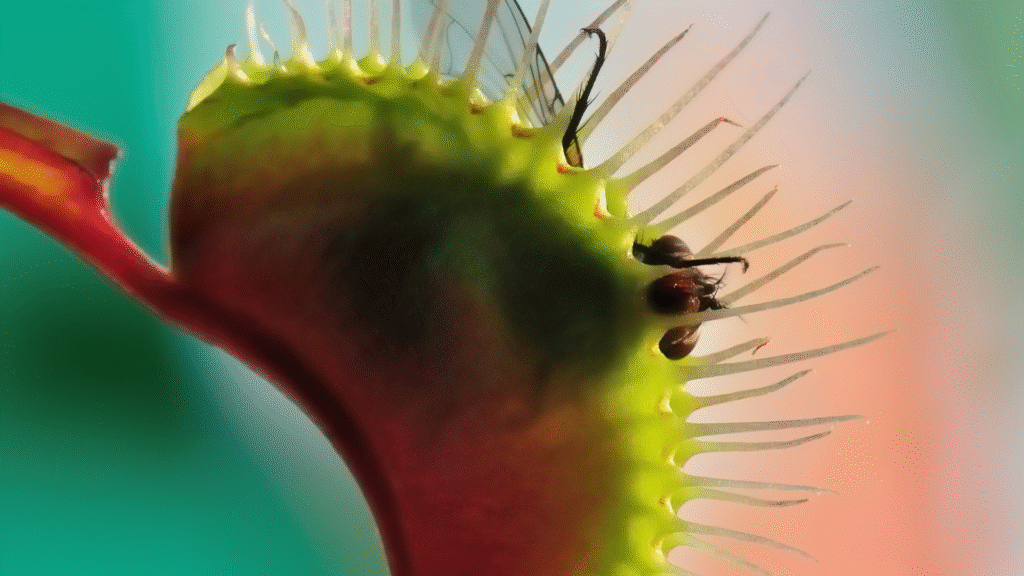
The Venus flytrap has become a symbol of plants that hunt because it chooses when to close. One touch primes the system; a second touch within a short interval confirms “living prey”, and only then does the trap snap. Continued movements can trigger tighter closure and more enzyme secretion a thrifty algorithm for a costly action.
Bladderworts: speed under water
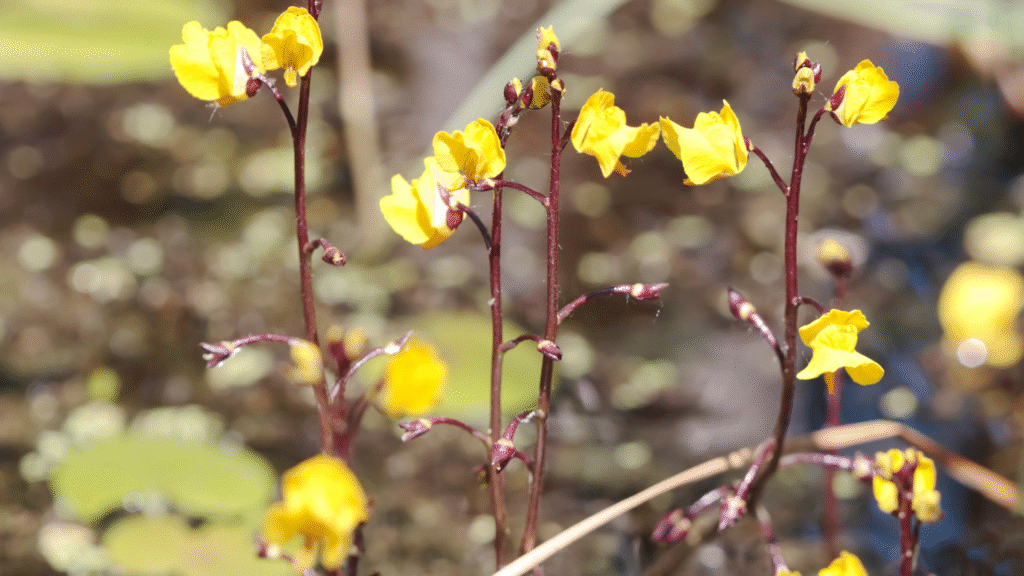
In Utricularia, negative pressure turns leaves into spring – loaded syringes. Brush the trigger hair, the door swings, and the plant drinks the world – micro-crustaceans, larvae, even algae bundles. The door then seals, pumps resume, and digestion proceeds.
Pitcher plants: chemistry, physics, and sometimes vertebrates
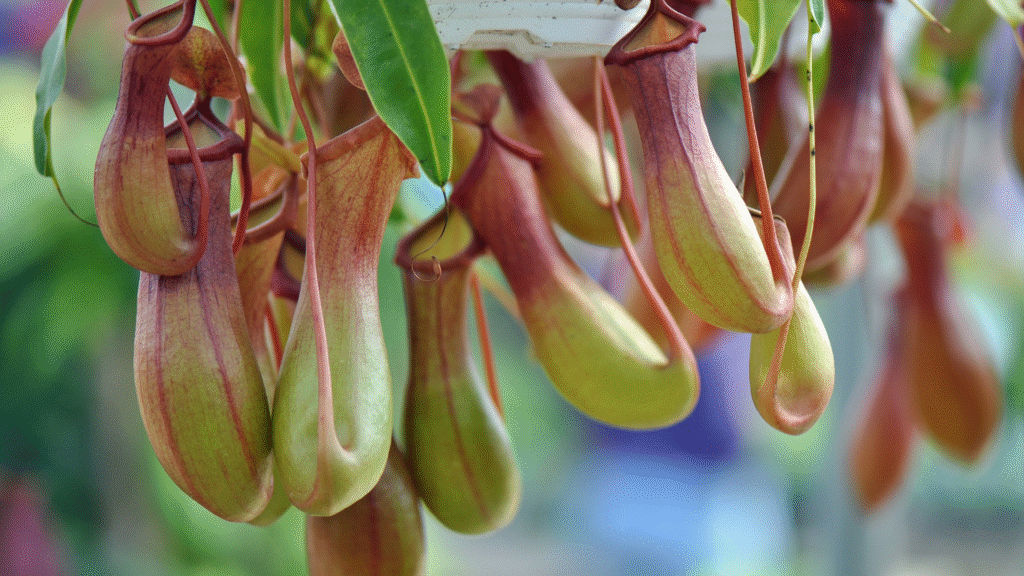
Tropical Nepenthes do more than catch flies. Some species (like N. rajah and relatives) hold vast volumes; there are documented cases of trapped frogs, lizards, and rarely small mammals. Others have evolved mutualism: tree shrews lick nectar on the lid and “deposit” nitrogen into the pitcher fertilizer delivered on schedule. Fluid chemistry varies by species: some pitchers are surfactant-rich (prey can’t escape), others harbor microbiomes that help break prey down.
Sundews: patience rewarded
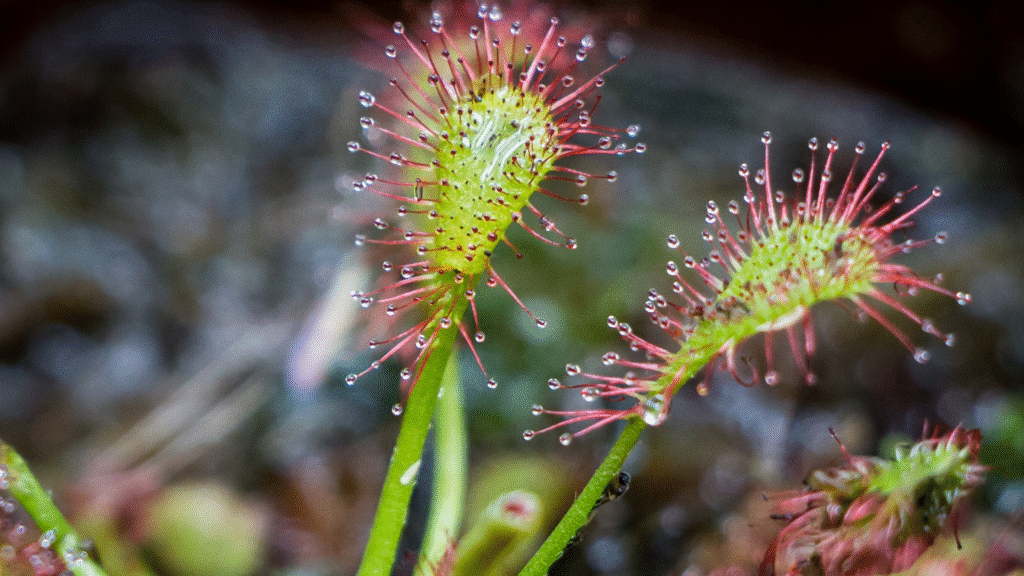
A sundew leaf looks delicate, but its hydraulics are relentless. Once an insect is glued, the tentacles bend inward over hours, increasing contact with enzymes and reducing the chance of escape. Darwin called it “slow politeness at dinner.”
The biophysics behind the magic
- Electrical signaling (variation potentials) helps coordinate fast movements in snap traps.
- Hydraulic instabilities and cell wall mechanics allow rapid shape changes without muscle.
- Enzymes (proteases, phosphatases, chitinases) and pitcher-fluid microbes turn prey into ions plants can absorb.
- Cost–benefit economics governs when traps fire and how long digestion lasts movement and enzyme production are expensive, so the system is conservative.
Are plants… learning?
Plants lack neurons, yet some behaviors look like habituation: repeated irrelevant stimuli can reduce responses. In carnivores, “counting” touches in flytraps and energy-saving thresholds in sticky traps feel like primitive information processing. It’s safer to say signal integration and memory-like states, but the effect is the same: fewer false alarms, more meals.
Worlds where they thrive
- Acidic bogs (sundews, butterworts, flytraps).
- Tropical canopy edges and ultramafic soils (Nepenthes).
- Oligotrophic lakes and ditches (bladderworts).
Where roots cannot feed, leaves become chefs.
Field notes, myths, and growing them right
- Do not feed hamburger. Traps evolved for small invertebrates; rich, fatty foods rot and kill tissue.
- Use rain, RO, or distilled water. Minerals from tap water burn roots in bog species.
- Full light, poor soil. Peat-free mixes with inert media (e.g., sphagnum, perlite) mimic nutrient poverty they need.
- Don’t trigger for fun. Every closure costs energy; needless snaps weaken the plant.
Conservation: hunters in trouble
Wild populations suffer from habitat loss, altered hydrology, peat extraction, and poaching. Many pitcher plants and flytraps are protected; reputable nurseries propagate from tissue culture. The most ethical “dinner theater” happens at home, not in poached bogs.
Why they capture us
Because plants that hunt invert assumptions. They blur the line we drew between “animal doers” and “plant receivers”. They reveal how plastic life can be rewriting leaves into traps, rain into solvent, insects into fertilizer. And they remind us that the word passive rarely fits nature.
Nature’s patterns, nature’s riddles
If the idea of plant “decision-making” makes you curious about how matter might hold traces of events, you’ll like our deep dive into Water Memory – a careful look at claims and physics around whether water can retain a “history” of what touched it.
If you enjoy landscapes that rewrite themselves, sail over to Disappearing Island – where phantom lands flicker in and out of maps like a cartographer’s mirage.
Final thought
We may never meet a greener predator than a pitcher brimming with rain and enzymes or a flytrap counting footfalls. But the lesson of plants that hunt is bigger than appetite: life solves problems elegantly, often invisibly, and sometimes with a snap you can barely see but never forget.
If you enjoy stories like this, follow our channel Wonderful World – where the strange and the real meet.