
Introduction
Every once in a while, engineering pulls off a stunt that makes you question your own eyes. You look at it and think, “No way this works.” And yet – it does.
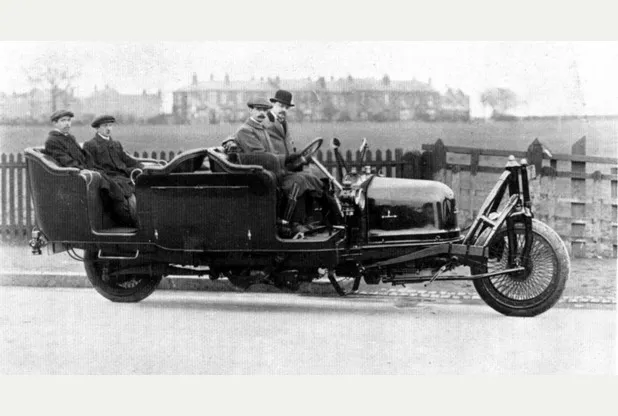
That’s exactly the case with Pyotr Shilovsky’s gyrocar, a machine that, on paper, looked like a joke, but on the streets of London in 1914 turned into a full-blown spectacle.
Imagine this: a long, heavy, almost three-ton car rolling down the road… on just two wheels. No wobbling. No tipping. And it could stay upright even when standing still – as if someone secretly glued it to the vertical position.
All because of one huge, spinning flywheel hidden inside the body.

Pyotr Shilovsky
The First Miracle on Two Wheels
Shilovsky’s gyrocar wasn’t a fantasy sketch or a lab test model. It was a real, full-size, working automobile. Built by Wolseley Motors and unveiled on the streets of London in May 1914, it immediately grabbed attention.
People stopped in their tracks. A two-wheeled car looked like an error in physics. But once the flywheel spun up, the whole contraption came alive – standing tall and balanced, like it had its own secret sense of equilibrium.
How the system actually worked
At the heart of the machine was a massive 600-kilogram flywheel.
Picture a metal disk nearly 1 meter in diameter and 12 cm thick, spinning at high speed – that’s a whole steel planet rotating inside the body.
It was powered by a 110-volt electric motor rated at about 1.25 hp, connected to a dynamo driven by the car’s main engine. Two additional 50-kg pendulums helped the machine react to shifts in balance.
Together, these components formed a primitive but surprisingly effective gyroscopic stabilizer that kept a 2750-kg automobile perfectly upright. The car could remain standing without moving – simply because a giant spinning disk took care of the balance.
Why People Were Shocked
In the early 20th century, cars were straightforward: four wheels, a frame, an engine, and off you go. And suddenly – a two-wheeled, full-size automobile? It looked like something from a science-fiction illustration.
People came closer, trying to find hidden supports. But there were none.
The gyrocar rode smoothly and confidently. Its only real weakness? Sharp turns.
When the driver tried to take a curve too aggressively, the flywheel couldn’t fully compensate for the sudden shift and the balance would falter. But in normal operation, the car performed far better than skeptics expected.
What Happened to the Gyrocar
Sadly, timing wasn’t on Shilovsky’s side. A few months after the public demonstration, World War I broke out, and the project was shelved. The gyrocar was put into storage and forgotten.
It resurfaced briefly in 1938, when it was restored – a small spark of renewed interest. But that was the last time it saw daylight.
In 1948, Wolseley scrapped the machine.
Not because it failed – but because the world had moved on.
Why It Still Matters
Shilovsky’s gyrocar didn’t become a mass-market vehicle, but it proved something important: even a huge machine on two lonely wheels can stay upright if you give it the right physics.
Today, similar principles live on in:
- balancing robots,
- monowheels,
- experimental transport platforms,
- and gyroscopic stabilization systems.
It was naïve? Maybe. Bold? Absolutely.
And ideas like this are exactly what push engineering forward.
Conclusion
Looking at the old photos of this long, narrow, heavy machine standing confidently on two wheels, it’s hard not to feel a bit of affection. Shilovsky’s gyrocar is a reminder that engineering moves not only through rules – but through the courage to break them.
Who knows – if history had played out differently, two-wheeled cars might have been as common today as electric ones.
👉 Think this was wild?
Then meet its even stranger cousin:
Monowheel – The One-Wheeled Wonder That Never Worked