
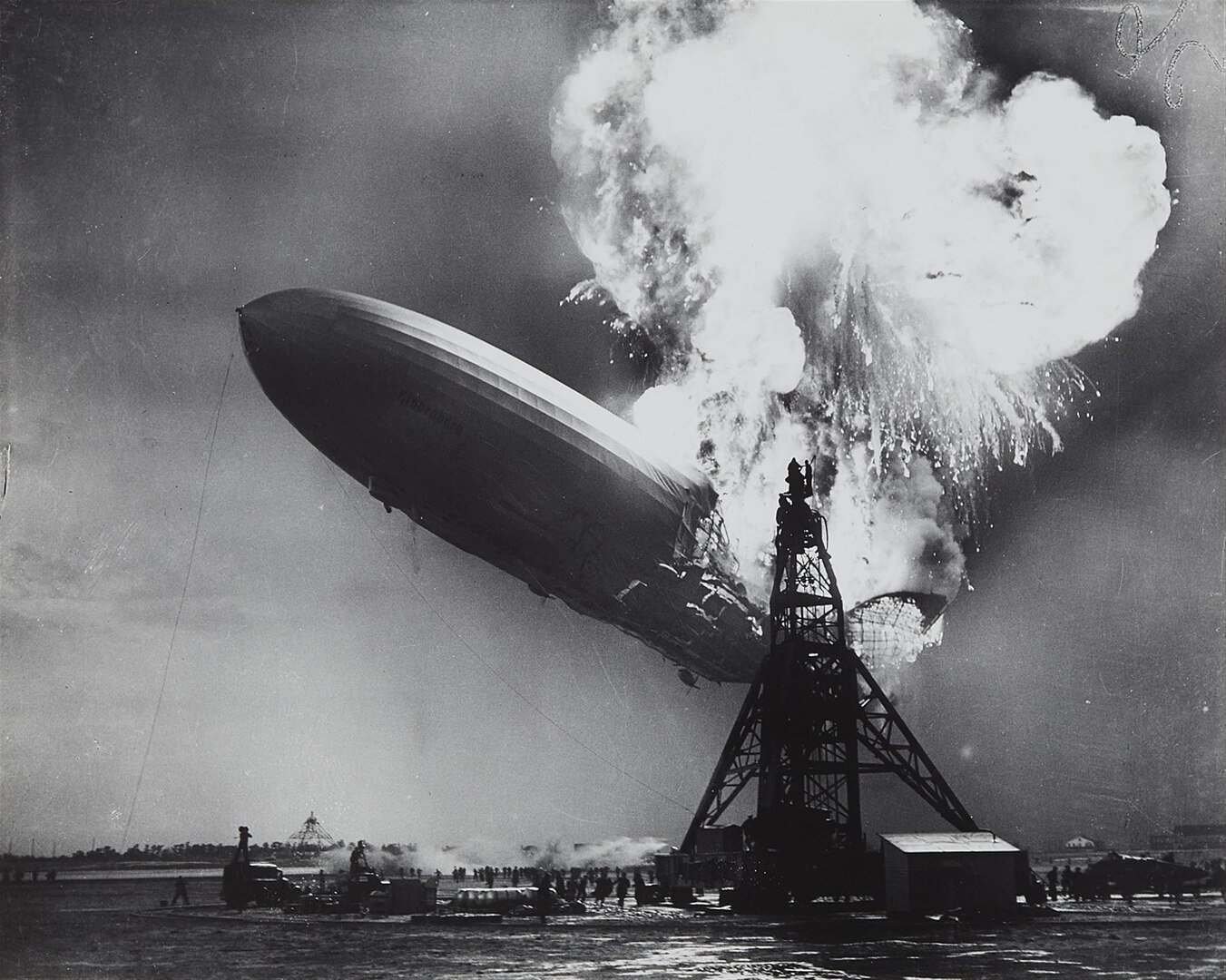
What the Hindenburg Was

Author: U.S. Department of the Navy. Bureau of Aeronautics. Naval Aircraft Factory, Philadelphia, Pennsylvania (USA). This notation does not indicate the legal status of the work. A normal license template is still required. See the Wikimedia Commons licensing policy for more details. Public domain, https://commons.wikimedia.org/w/index.php?curid=636539
Back in the 1930s, airships were seen as the future of flying.
Huge floating machines that could cross oceans in comfort and style.
No loud engines, no turbulence – just quiet travel above the clouds.
The most famous of them all was the Hindenburg (LZ 129).
A German airship about 245 meters long – longer than two football fields.
Inside, there were cabins, a restaurant, even a smoking room (yes, really – with special ventilation).
It could travel from Germany to America in two or three days.
It looked like the future of luxury travel.
But in May 1937, everything changed in just half a minute.
The Day of the Disaster
On May 6, 1937, the Hindenburg approached Lakehurst, New Jersey, at the end of its flight from Germany.
There were 97 people on board – 36 passengers and 61 crew members.
The weather was bad: wind, rain, and storms.
The airship circled for hours, waiting for conditions to improve.
In the evening, the wind finally calmed, and the crew started the landing.
Everything seemed normal – they dropped the mooring ropes and began lowering altitude.
People on the ground were ready to pull the ship in.
Then, suddenly, someone saw a flash near the tail.
A second later, fire appeared.
It spread fast – flames ran along the body of the airship.
In just 34 seconds, the Hindenburg was completely on fire and fell to the ground.
People and Survival

Author: Associated Press. eBayfrontback, Public Domain, https://commons.wikimedia.org/w/index.php?curid=37553042
The fire looked impossible to survive, but 62 people lived.
36 people died – 35 on board and one on the ground.
It’s hard to believe, but many survived because the airship was already quite low – about 100 feet above the ground.
Some jumped. Others crawled out through holes in the fabric.
Ground crews ran straight into the fire to pull people out.
Radio reporter Herbert Morrison was there that evening.
His shocked voice was recorded live: “Oh, the humanity!”
That short cry became world-famous – the sound of disbelief and grief all at once.
Why the Hindenburg Caught Fire

Author: Wide World Photos. eBayfrontback, Public Domain, https://commons.wikimedia.org/w/index.php?curid=31586432
The exact cause was never proven, but experts agree on one main version:
- There was a hydrogen leak near the tail.
- The airship built up static electricity in the humid air.
- When it connected to the mooring lines, a spark ignited the leaking gas.
The Hindenburg was supposed to use helium, which doesn’t burn.
But in the 1930s, the U.S. refused to export helium to Germany, so engineers had to use hydrogen – cheaper, lighter, and extremely flammable.
Technically, everything was built well. But that one compromise – using hydrogen – made all the difference.
Human Mistakes
Beyond the gas itself, there were other human factors:
- The crew was under pressure – the flight had already been delayed.
- They made quick balancing adjustments with ballast and gas.
- The weather was unstable.
None of these things alone caused the crash.
But together, they created the perfect chain of small problems that ended in disaster.
What Happened After
After the fire, people lost faith in airships.
The images of the burning Hindenburg were everywhere – in newspapers, on posters, on the radio.
That one event ended the era of passenger airships.
No one wanted to fly on something filled with explosive gas ever again.
Airplanes were getting faster and safer, and they soon took over long-distance travel.
In one moment, the dream of calm, floating travel in the sky was gone.
Important Facts
- The whole disaster lasted just 34 seconds.
- 97 people were on board.
- 62 survived, 36 died.
- The main cause: a hydrogen fire, likely triggered by static electricity.
- The event marked the end of the airship era.
Why It Still Matters
The Hindenburg disaster is more than an old tragedy. It’s a lesson.
Sometimes progress hides small risks that everyone knows about but ignores.
People back then knew hydrogen was dangerous, but they hoped nothing would happen.
It’s a pattern we still see today – pushing deadlines, taking shortcuts, trusting that “it’ll be fine.”
Until one day, it isn’t.
The End of an Era
After May 6, 1937, airships never recovered.
The Hindenburg disaster made people realize that flying safely at high altitudes required something different – wings, engines, and airplanes.
In a strange way, this disaster helped move aviation forward.
It showed that comfort means nothing without safety.
And that even the most beautiful machines can fail because of one simple choice.
The Hindenburg was supposed to be a symbol of progress.
Instead, it became a symbol of how fragile progress really is.
👉 Want to read how it all began? Check out the previous story: The Montparnasse Train Accident – When Progress Failed to Stop