
A Normal Morning
December 6, 1917.
Halifax, Nova Scotia, Canada.
It started like any other winter morning. People were walking to work, kids were heading to school, trams and carts filled the streets. Down by the harbor, workers were loading and unloading ships.
It all looked routine.
No one knew that within minutes, the city would be gone.
How It Began

That morning, two ships were entering and leaving the harbor.
The Norwegian ship “Imo” was heading out to sea, and the French ship “Mont-Blanc” was coming in.
The “Mont-Blanc” was carrying a deadly cargo – 2,900 tons of explosives: TNT, picric acid, benzol, and nitrocellulose.
It was basically a floating bomb.
The crew of the “Mont-Blanc” knew how dangerous their load was. The ship even flew a red flag meaning “explosives on board.” But Halifax Harbor was narrow, and traffic was busy.
When “Imo” and “Mont-Blanc” saw each other, both tried to turn. There was confusion, mixed signals, and shouting. A few seconds later, the two ships collided.
The Fire
The crash wasn’t violent, but it tore open the “Mont-Blanc’s” hull.
Barrels of benzol spilled and caught fire.
The French crew instantly knew what would happen next. They shouted for people to get away, then abandoned ship and rowed toward shore.
But the people of Halifax didn’t understand the danger. They gathered to watch the burning ship drift toward the docks – some even thought it looked “interesting.”
Twenty minutes later, their city was gone.

By William James (Toronto) – Derivative of File:DNDHfxExplosion-2.jpg. Nova Scotia Archives and Records Management, Negative Number DNDHfxExplosion-2, Public Domain, https://commons.wikimedia.org/w/index.php?curid=5751389
The Explosion
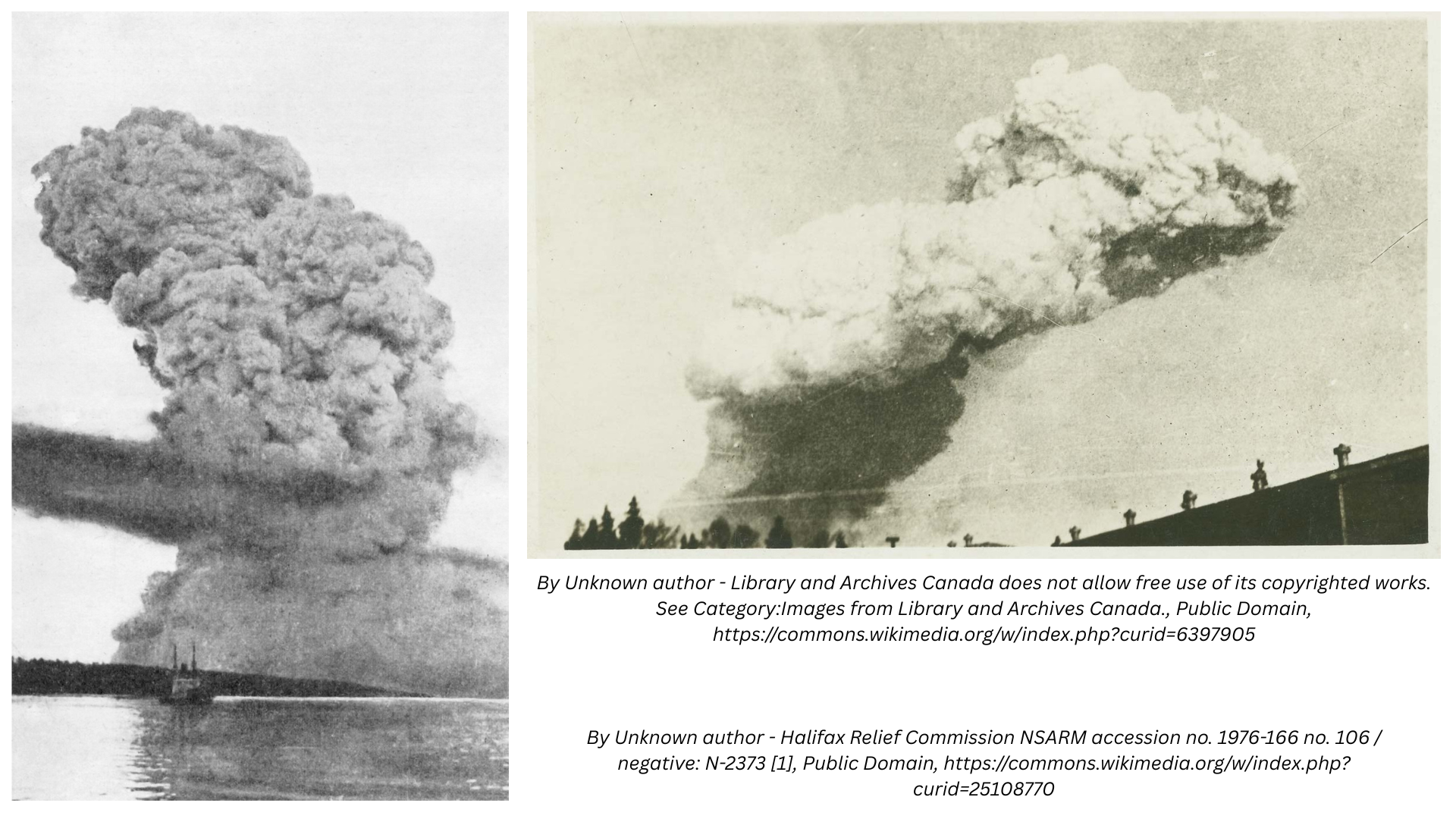
At 9:04 a.m., the “Mont-Blanc” exploded.
It was the largest man-made explosion in history before the atomic bomb.
The blast was equal to about 3,000 tons of TNT.
Half the city was destroyed in seconds.
A massive mushroom cloud rose over Halifax. The shockwave flattened buildings, threw ships onto the shore, and shattered windows for miles.
Pieces of the “Mont-Blanc” were found up to 5 kilometers away.
The explosion was heard over 300 kilometers away – even in the U.S. state of Maine.
The Aftermath
Downtown Halifax was gone.
Over 2,000 people were killed, and about 9,000 were injured.
Thousands of homes were destroyed, and what was left soon caught fire.
To make it worse, minutes after the explosion, a tsunami nearly 18 meters high hit the waterfront, flooding the ruins and killing even more people.
The city looked like a war zone. Streets were gone, houses leveled, people trapped under rubble. Those who survived faced freezing temperatures – it was below zero, and many had lost everything, even their clothes.
Help Arrives
Rescue efforts started almost immediately.
Medical teams came from nearby towns, and by the next day, a special train arrived from Boston with doctors, nurses, and supplies.
The help from Boston was so quick and generous that even today, Halifax sends Boston a Christmas tree every year as a thank-you. It’s a tradition that still continues.
Why It Happened
The official investigation found both captains at fault – the Norwegian and the French.
Each had made navigation mistakes, and both misunderstood each other’s signals.
But the real issue was poor traffic control.
There were no clear rules for handling dangerous cargo or for ship movement in the harbor.
After this disaster, ports all over the world rewrote their safety rules. Stricter regulations for explosive cargo and harbor communication came directly from what happened in Halifax.
The Damage
Around 12,000 buildings were damaged or destroyed.
Entire neighborhoods simply vanished.
Thousands of people lost their sight from flying glass when windows shattered during the blast.
The city took years to rebuild, and in many ways, Halifax became a new city rising from ashes.
Why It Matters
The Halifax Explosion wasn’t just an accident – it was a chain of small mistakes, bad timing, and missing safety rules.
It’s a reminder that even ordinary systems – shipping, transport, routine work – can fall apart if no one pays attention to details. One wrong move can destroy everything.
The Day the City Disappeared

By Jesse David Hollington from Toronto, Canada – Halifax Explosion Memorial Bell Tower, CC BY 2.0, https://commons.wikimedia.org/w/index.php?curid=3670253
On that morning in 1917, one ship destroyed an entire city.
Thousands dead, tens of thousands injured, a shockwave that shook half of Canada.
It was a tragedy few outside the country remember, but it changed safety standards worldwide.
Today, in Halifax, there’s a memorial with two simple words:
“We Remember.”
👉 Want to read another story about human error and progress? Check out The Hindenburg Disaster – 34 Seconds That Ended an Era.