
The mystery of the disappearing island
Imagine this: a ship sails through calm waters. Suddenly, through the morning mist, a piece of land appears – rocky, green, covered with seabirds. The captain marks it on the map, gives it a name… and years later, it’s gone.
No storm, no explosion. Just gone.
Then, decades later – it’s back again.
It sounds like a sailor’s tale, but this disappearing island has been documented for centuries. These so-called phantom islands have been mapped, described, argued about and then erased from the world’s geography as if they never existed.
The case of Sandy Island
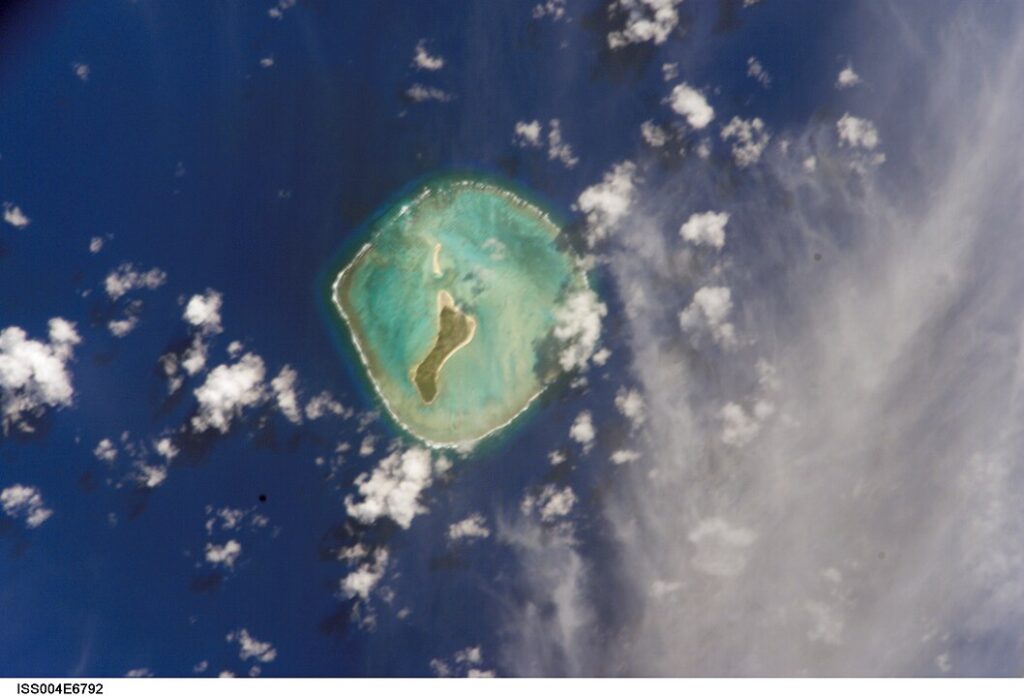
Earth Sciences and Image Analysis Laboratory, NASA Johnson Space Center. http://nicmosis.as.arizona.edu:8000/ECLIPSE_WEB/ECLIPSE_05/ONEO_ISS.html,Public domain, https://ru.wikipedia.org/w/index.php?curid=7021279
In 1774, a British ship named Lady Nelson reported a new island near New Caledonia. They called it Sandy Island. For over two centuries, it appeared on maps, atlases, and even digital charts.
But in 2012, researchers aboard the Australian vessel RV Southern Surveyor decided to check it out. They reached the exact coordinates and found nothing but deep ocean.
No sand, no reef, no land – just open sea more than 1,300 meters deep.
Within months, Google Maps and official nautical charts deleted Sandy Island. But the question remained:
If it never existed, what did those sailors see back in 1774?
Why the disappearing island confused scientists
Scientists suggest that Sandy Island may have been a pumice raft – a floating mass of volcanic rock created by underwater eruptions. These rafts can stretch for kilometers, look solid from a distance, and even fool navigation instruments.
Others believe it was simply a mapping error.
In the age of exploration, coordinates were often imprecise. Two ships might observe the same spot from different angles and mistakenly mark two islands instead of one.
Over the centuries, such disappearing islands multiplied: Bermeja in the Gulf of Mexico, Frisland in the North Atlantic, New Sheba in the Indian Ocean, and many more.
The political ghost: Bermeja Island
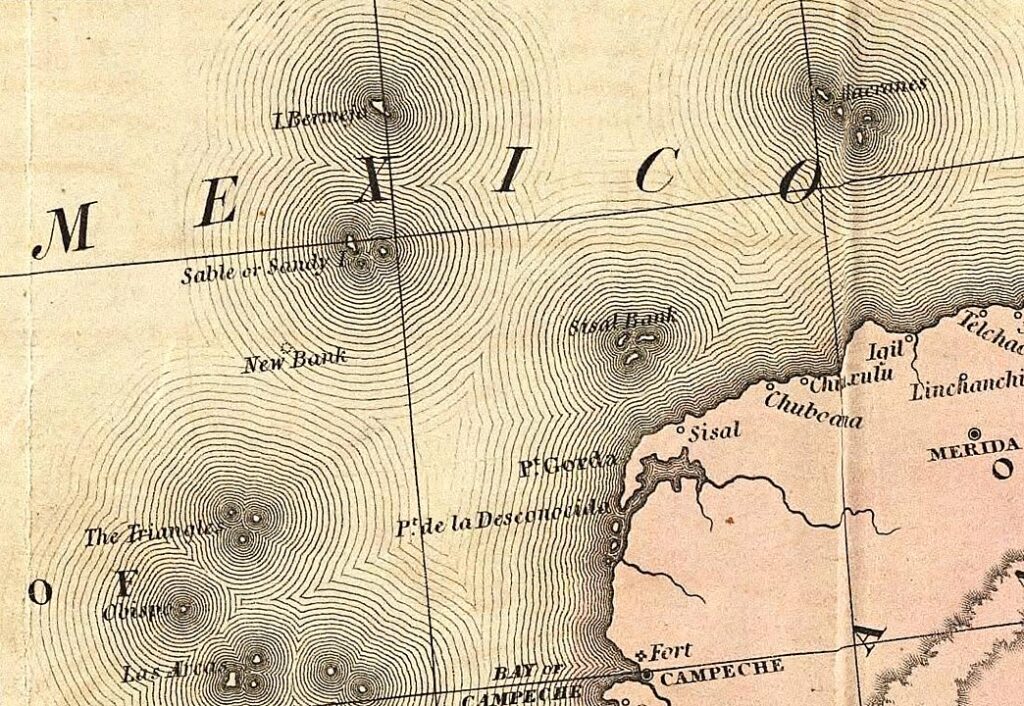
Author: Tanner, Henry S.. A Map of the United States of Mexico, 3rd ed., Public domain, https://commons.wikimedia.org/w/index.php?curid=6217657
Among all vanishing islands, Bermeja stands out for its geopolitical drama. Spanish sailors recorded it in the 16th century, and it appeared on maps for hundreds of years.
In modern times, Mexico tried to locate Bermeja again – because if the island existed, it could extend the country’s maritime borders and oil rights.
Several expeditions searched the area.
Nothing was found.
U.S. geographers claimed the island never existed.
Some Mexican officials, however, suspected something darker – that the island might have sunk after an underwater earthquake, or worse, been intentionally destroyed to shift territorial boundaries.
No proof ever surfaced, but the story turned Bermeja into a modern myth – where geography meets politics.
Volcanic worlds: when islands are born and die
Not all “disappearing islands” are illusions. Some are truly alive – shaped by the ocean itself.
In Japan, the volcanic island Nishinoshima has been born and reborn multiple times in recent decades. Eruptions push it above the surface, waves wear it down, and the cycle repeats – nature’s slow breathing made visible.
In 1973, near Tonga, an undersea eruption created Surtsey, a brand-new island that became a natural laboratory for scientists. They watched as life took hold – moss, bacteria, birds. A new world from fire and ash.
Years later, part of Surtsey slipped back beneath the sea.
The ocean doesn’t like permanence.
It gives and takes back – as if reminding us who’s really in charge.
Why we’re still fascinated by the disappearing island
Maybe because it proves something comforting – that even in an age of satellites and GPS, the Earth still keeps secrets.
We think we’ve mapped everything.
But every now and then, the sea reminds us that our maps are only guesses.
Out of fog or foam, a shadow of land appears.
And we’re reminded how fragile our knowledge truly is.
A world that breathes
Over 150 disappearing islands have been officially removed from global maps in the past two centuries. Some were errors. Some were illusions. Some – perhaps – were real, but didn’t want to stay.
Maybe the planet itself plays with us – a slow, patient storyteller rewriting her own geography.
Final thought:
Whether it’s a disappearing island or one reborn from fire and sea, the ocean reminds us that nothing on Earth is truly permanent.
Curious about more hidden wonders of our planet? Dive into our articles Water Memory and see how nature loves to surprise us. 🌍
If you enjoy stories like this, follow our channel Wonderful World – where the strange and the real meet. 🌍