
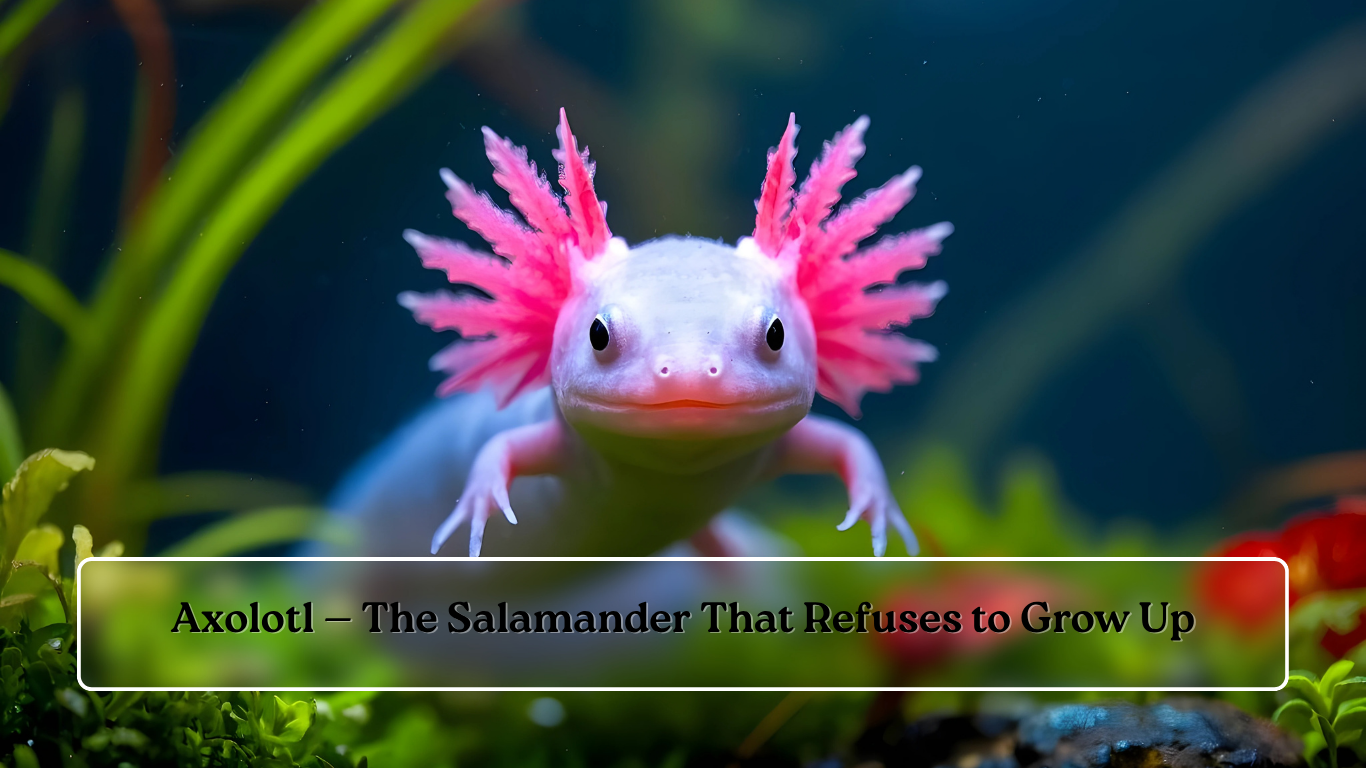
The axolotl is one of those creatures that breaks not only biological rules but also basic logic. It’s an animal that seems stuck between childhood and adulthood and simply decided, “Why grow up at all?” While other salamanders go through a full transformation, the axolotl keeps its juvenile traits for life. And the more you learn about it, the more unbelievable it seems that nature allowed something like this to exist.
A world where the axolotl plays by its own rules
Axolotls come from the high-altitude lakes of Mexico. Once there were several of them, but today, only the canals and remnants of Lake Xochimilco remain. Imagine ancient Aztec lands, floating gardens, morning mist over the water and somewhere in this landscape lives a small predator that acts like time doesn’t matter.
Visually, an axolotl looks almost cartoonish: a wide head, a permanent little smile, and feathery gills that sway with every movement. Its expression feels like it’s saying, “Hey, I know something you don’t.” And honestly, it probably does.
Why the axolotl “refuses” to grow up
In biology, this phenomenon is called neoteny – when an animal becomes sexually mature while keeping its juvenile appearance. But the axolotl takes this to an extreme: it doesn’t just look like a larva, it stays a larva while living a full adult life.
Scientists still debate why. One idea is that it’s related to the cool, stable waters of mountain lakes. Metamorphosis is a demanding process, and for the axolotl, it may simply be easier and safer – not to change.
But here’s the funny part: if you “help” an axolotl – by altering hormones, for example – it can transform into a normal salamander. Yet in nature, it never chooses to do so. And honestly, who can blame it? Why change if life works fine as it is?
A regeneration master any superhero would envy
One reason the axolotl became a scientific superstar is its insane regeneration abilities. It can regrow far more than limbs. Its list includes:
- its entire tail,
- legs – multiple times, with no loss in quality,
- parts of the spinal cord – fully functional,
- sections of the heart,
- even parts of the brain.
Think about that: in a world where humans heal wounds for weeks, the axolotl simply grows back what’s missing. No scar. No deformity. As if nothing happened. Scientists believe that studying axolotls may someday transform regenerative medicine.
A symbol of ancient cultures
For the Aztecs, the axolotl wasn’t just an animal – it was sacred. They connected it to Xolotl, the brother of Quetzalcoatl. According to legend, Xolotl didn’t want to be sacrificed and turned into an axolotl to hide in the water. The creature’s “eternal childhood” became a symbol of avoiding death itself.
Today, the axolotl is a cultural icon in Mexico City – appearing on souvenirs, murals, and street art. And honestly, it deserves that fame.
Why the axolotl is in danger
Even though axolotls are internet-famous and widely kept in labs, they are critically endangered in the wild. Several factors are responsible:
- the destruction of natural lakes,
- Mexico City’s expansion,
- water pollution,
- invasive fish that eat their young,
- climate changes.
Scientists and conservation groups are restoring habitats, building artificial canals, and protecting remaining areas. But it’s not easy – axolotls depend on clean, cool, stable water.
Axolotls as pets – cute, strange, and surprisingly demanding
People all over the world keep axolotls as pets, and yes, they are adorable. But they’re also more complicated than they look:
- they need very clean, cold water,
- temperature changes can stress them instantly,
- they require a proper diet (live or frozen food),
- they’re sensitive to substrate and tank conditions.
So yes, they’re cute – but also a bit high-maintenance.
Why axolotls fascinate us so much
There’s something almost philosophical about a creature that never grows up. It lives slowly, calmly, as if outside the flow of time. When you look at an axolotl – especially its permanent little “smile” – you get the feeling it’s reminding us of something simple: not everything in nature obeys the rules. Sometimes being yourself is enough.
Conclusion
The axolotl is a tiny biological mystery holding onto life with all its strength. It surprises with its abilities, inspires scientists, and wins people’s hearts. And although its future in the wild is uncertain, it has already become a symbol of uniqueness, rarity, and nature’s ability to astonish.
👉 Want to explore more of the natural world’s wonders? Read our article “Kakapo – the Parrot That Can’t Fly but Captured the World’s Heart”