
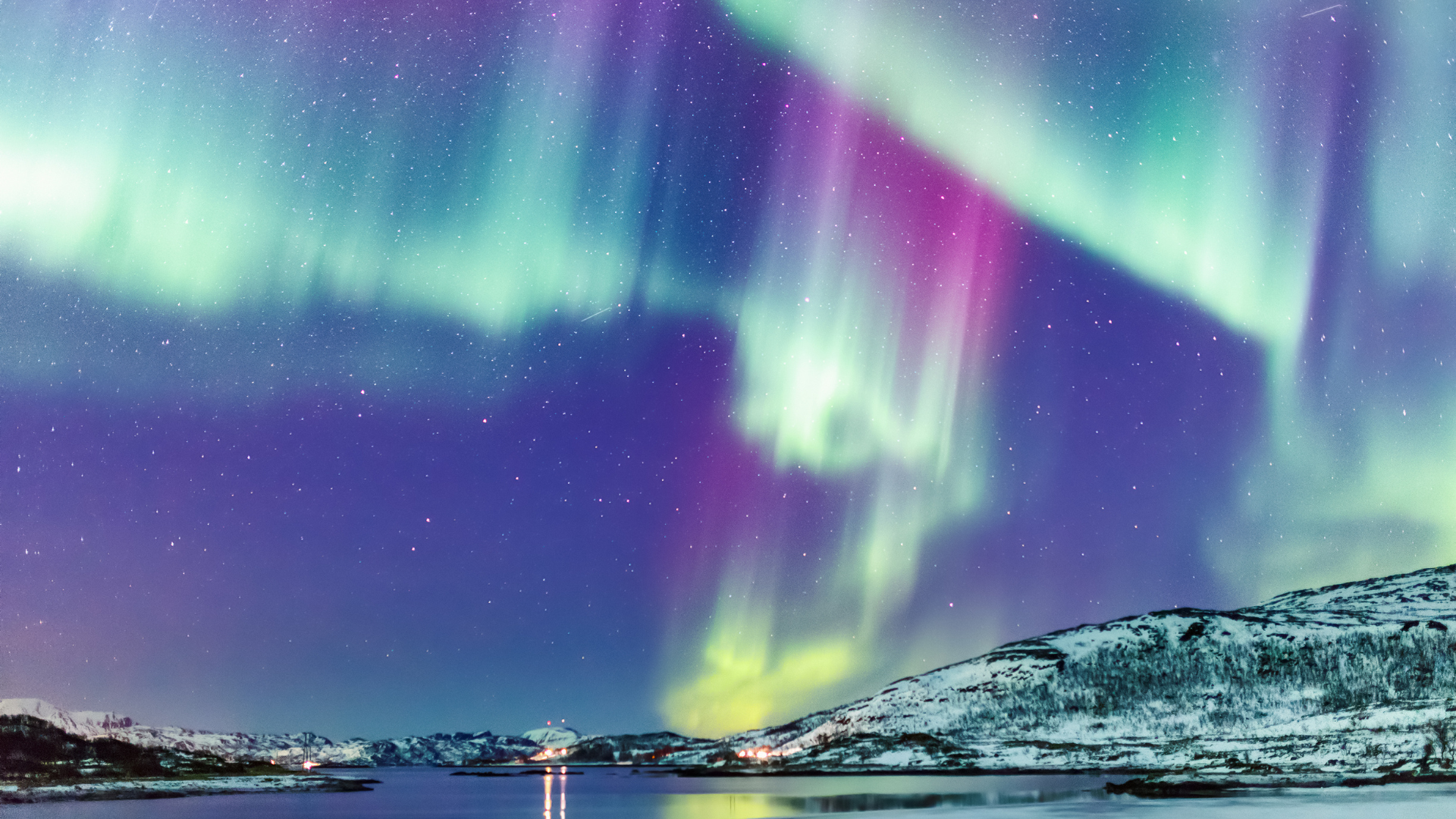
There are nights when the sky decides to speak.
Not with thunder or words – but with light.
The aurora borealis, flowing like breath itself, turns the frozen silence into movement – a living conversation between Earth and the Sun.
And if you’ve ever stood beneath it, you know: this isn’t just a natural event. It’s something ancient, something that feels alive.
Where Legends Were Born
Before scientists called it the aurora borealis, people called it what they felt.
For the Sámi, it was the breath of the spirits, gentle yet dangerous.
The Inuit believed the aurora borealis was a playground for souls, tossing a glowing ball across the heavens.
The Vikings saw it as the glint of armor – reflections of unseen battles in the night sky.
In Iceland, pregnant women were told not to look – fearing their child would inherit a twisted gaze.
In Japan, they believed a child conceived under the aurora borealis would be blessed for life.
And across Alaska, people whispered warnings:
don’t whistle at the lights – or they might notice you and carry you away.
Even now, when we know what causes it, something inside still stirs when the sky begins to glow.
It’s not fear, not exactly. It’s reverence. That quiet realization that we are small – and the universe is not.
The Science of the Aurora Borealis
Science gave it a name – but not meaning.
The aurora borealis happens when charged solar particles collide with Earth’s magnetic field,
creating storms of color high in the atmosphere.
When those particles meet oxygen or nitrogen, they burst into light:
green, red, purple, blue – every shade a whisper of chemistry.
But knowing this doesn’t kill the magic.
It only deepens it.
Because these particles travel millions of kilometers through dark space,
only to end their journey in a silent dance above our heads.
It’s as if the universe sends us postcards made of light –
a reminder that even the coldest winds can create beauty.
Some say the aurora borealis even sings.
A faint hum, heard only by a few, like the sky exhaling.
Scientists call it electromagnetic noise.
But if you’ve ever heard it, you know – it’s not sound. It’s presence.
When the Sky Burns Without Fire
In 1859, during the Carrington Event, the aurora borealis spilled far beyond the Arctic.
It painted the skies of Rome, Cuba, even Hawaii – blood-red, ghostly, unreal.
Telegraphs sparked and failed. Compasses spun like they’d gone mad.
People thought the world was ending.
And maybe, in a way, it was – the world of certainty, of thinking we understood the heavens.
How fragile everything feels, standing under that light.
One flare from the Sun, and the whole sky bends to its will.
It’s humbling and beautiful, how easily the world can glow or vanish.
Where the Aurora Borealis Breathes the Loudest
If you chase the light, head north: Norway, Finland, Iceland, Canada.
Places where silence has texture, and time slows down to the rhythm of the wind.
Here, the aurora borealis doesn’t just appear – it performs.
In Lapland, entire hotels exist only for this show:
glass igloos with transparent roofs, so people can fall asleep beneath the glowing sky.
Forecasts announce not rain, but “aurora chances.”
And every traveler waits – shivering, hopeful – for the first shimmer across the horizon.
Sometimes it lasts seconds. Sometimes hours.
And sometimes, when everything aligns,
the whole sky becomes a moving ocean – green tides, violet ribbons, silver arcs.
You forget to breathe. Because it feels like the planet is breathing for you.
The Light That Enters You
The aurora borealis doesn’t just fill the sky – it enters you.
It moves quietly inside, rearranging your thoughts, humbling your heart.
You stop feeling like the center of the story and start feeling like part of it.
It’s not a coincidence that ancient myths called it a soul’s dance.
Under this light, you understand something simple and enormous:
we live on a breathing world.
And sometimes, the air itself glows to remind us.
When and Where to Find the Flowing Light
The aurora borealis appears between September and March, when nights stretch long and the cold keeps the air clear.
The further you go from cities, the stronger the silence – and the brighter the light.
On some nights, the aurora reaches far south, surprising even those who weren’t looking.
But if you really want to meet it, go north.
Stand still. Let the world go quiet.
And when the first green shimmer appears, don’t rush to photograph it.
Just breathe – the same air that’s glowing above you.
The Universe That Dances Between Fire and Ice
The aurora borealis is a paradox – fire that lives in the cold, motion born from stillness.
It’s proof that beauty doesn’t come from perfection, but from tension –
the meeting of opposites.
Maybe that’s why we never tire of it.
The Inuit once said: “The lights are the souls of those who danced well in life.”
Perhaps the aurora borealis is just that –
the sky remembering how to dance.
👉 Keep exploring: The Colors of the Earth