
A discovery at the bottom of the sea
Spring, 1900. Off the coast of a small Greek island called Antikythera, sponge divers stumbled upon the wreck of an ancient ship.
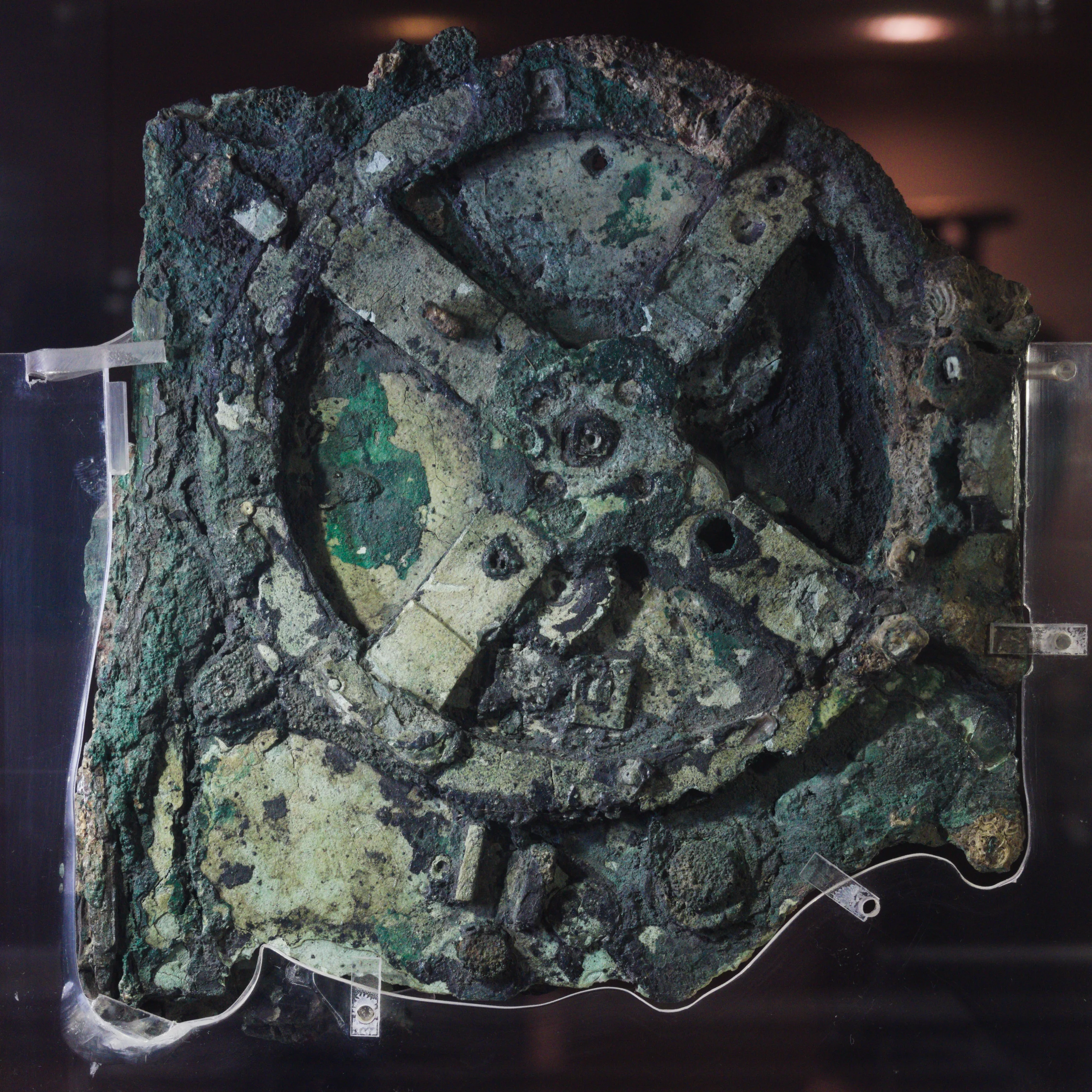
Amid statues, coins, and amphorae, they found something far stranger – a corroded lump of bronze, full of gears.
At first, no one paid attention. A few small wheels? Maybe a broken clock.
But clocks didn’t exist in the first century BCE.
It would take decades to realize what they had discovered – the world’s first mechanical computer, built more than 2,000 years ago.
What is the Antikythera Mechanism?
The Antikythera Mechanism is a bronze device roughly the size of a book, with more than 30 intricate gears inside.
It was designed to predict the movements of the Sun, Moon, and planets, track lunar phases, and even forecast eclipses.
In essence, it was an analog computer – created long before the word “computer” existed.
The scientists who brought it back to life
The mechanism lay forgotten in the Athens Archaeological Museum until the 1950s, when physicist Derek de Solla Price began studying it.
Using early X-rays, he revealed an astonishing network of interlocking gears with a precision thought impossible for ancient technology.
Later, in the 2000s, 3D scanning and X-ray tomography allowed scientists to read hidden inscriptions and reconstruct the entire system.
They discovered it wasn’t just an astronomical calculator – it even predicted the dates of the ancient Olympic Games.
Technology out of time
The Antikythera Mechanism is so advanced that its existence defies history.
Complex gear systems like this wouldn’t appear again until the 14th century.
Its craftsmanship – with perfectly cut bronze teeth and precise ratios – suggests an engineering knowledge we believed lost until the Renaissance.
Whoever made it didn’t just observe the sky – they understood it as a machine governed by mathematics.
Who could have built it?
There are several leading theories:
- The school of Archimedes – some believe it originated in Syracuse, where Archimedes worked on mechanical devices and astronomy.
- Hipparchus of Nicaea – the famous astronomer who discovered Earth’s precession; the mechanism may have been built from his models.
- An unknown Greek engineer – part of a tradition now lost, whose knowledge vanished with time and empire.
Whatever the case, the Antikythera Mechanism proves that ancient science was far more sophisticated than once thought.
What it could do
On its front and back dials, the Antikythera Mechanism displayed:
- Positions of the Sun, Moon, and known planets;
- Dates of solar and lunar eclipses;
- The phases of the Moon;
- The Metonic cycle – a 19-year lunar calendar;
- Timelines for major athletic events like the Olympics.
By turning a small crank, the user could fast-forward or rewind time – watching the heavens move like clockwork.
It was, in every sense, a miniature universe made of bronze.
The inscriptions that told the story
Over 2,000 tiny Greek letters are engraved on its plates – like a built-in instruction manual.
They mention “the Sun,” “the Moon,” “cycles,” “eclipses,” and “games.”
This proves the mechanism wasn’t ceremonial – it was a scientific instrument.
Some researchers believe it was used in teaching, or to demonstrate the cosmos to scholars and philosophers.
Precision beyond its age
Modern engineers who’ve replicated the Antikythera Mechanism confirm its accuracy:
it could predict eclipses with an error margin of less than one day every 19 years.
It even accounted for the uneven speed of the Moon’s orbit – a detail that European astronomers didn’t rediscover until 1,500 years later.
This level of precision suggests that ancient Greek science was not primitive – just forgotten.
The mystery of why it’s unique
No other device like it has ever been found.
Was it one of many, or a single masterpiece that survived by chance?
Bronze corrodes quickly, and most ancient machinery would have vanished long ago.
Perhaps dozens of such mechanisms once existed – lost to shipwrecks, melted down, or buried beneath time.
For now, this one lonely survivor speaks for all of them.
Modern reconstructions
Today, several museums display working replicas of the Antikythera Mechanism – including in Athens, London, and Zurich.
They move with mesmerizing beauty: gears spinning in harmony, the cosmos reduced to clockwork.
Each replica reminds us that progress is not a straight line.
Sometimes, the past was smarter than we imagine.
A message from the ancient world
The Antikythera Mechanism is more than a machine. It’s a message – proof that human curiosity has always reached for the stars.
It reminds us that genius can bloom, vanish, and be rediscovered centuries later.
It’s as if the ancient engineers left us a whisper across time:
“We understood the universe – do you still?”
Explore more ancient mysteries
Curious about other wonders that blur the line between science and the impossible?
- Water Memory – can water remember what it touched?
- The Mandela Effect – when millions remember what never happened.
- Lightning Survivors – how electricity can rewrite the human brain.
Each reveals that technology, memory, and mystery have always been intertwined.
Final thought
The Antikythera Mechanism is a riddle carved in bronze – a reminder that the future has already visited the past.
It stands as one of humanity’s greatest paradoxes:
a machine that shouldn’t exist, but does.