
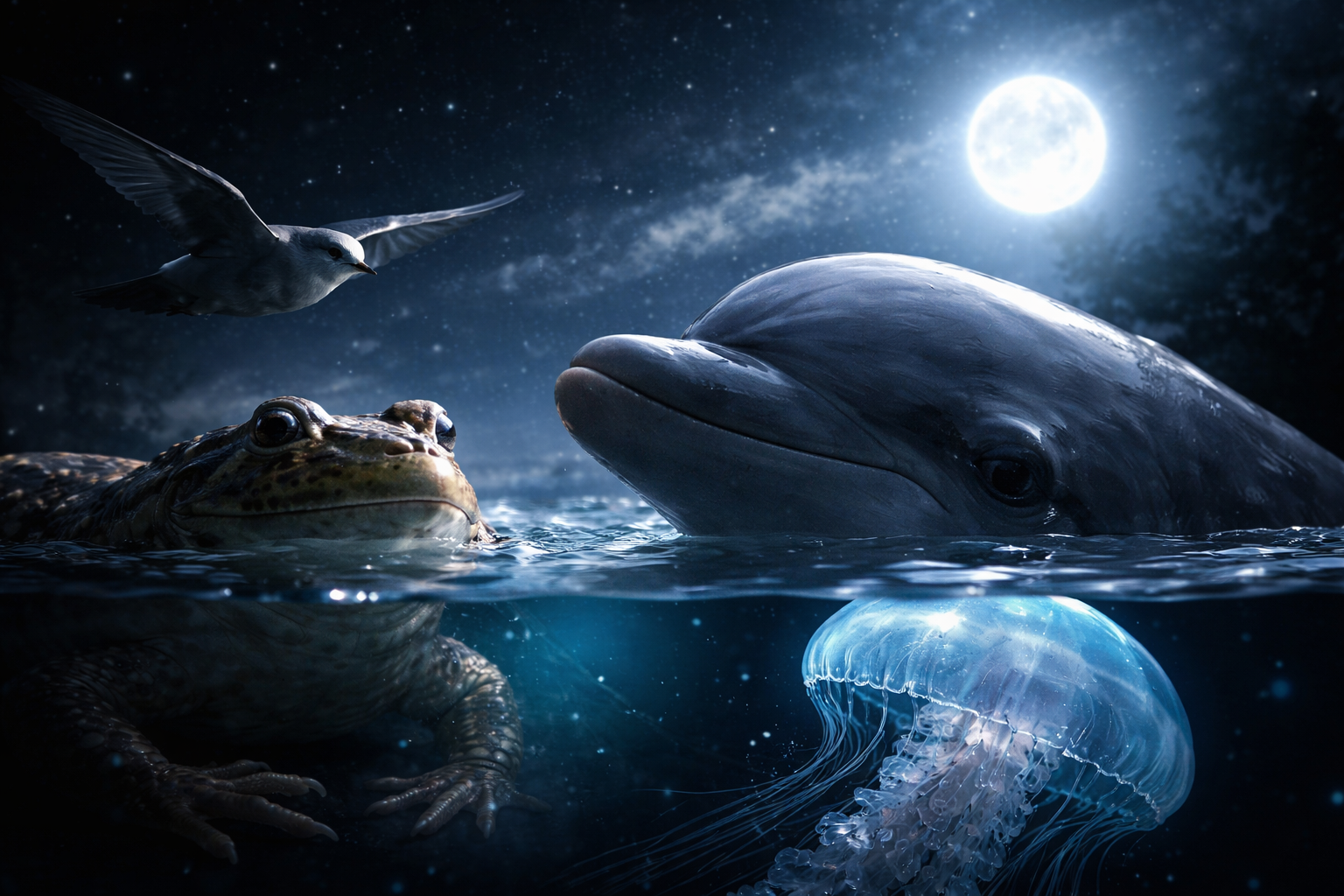
Imagine never sleeping. Not once.
No night break. No mental shutdown. Your brain always on. Your body always alert.
Sounds impossible, right? For humans it definitely is. Miss one night and you feel it. Miss two and everything starts falling apart. Focus drops. Reactions slow. Your body demands rest.
And yet there is this claim that keeps floating around.
Some animals never sleep.
Is that actually true? Or are we misunderstanding what sleep really looks like in the animal world?
Let’s take it step by step.
What Do We Even Mean by Sleep
Most of us think of sleep in a simple way. You lie down. Close your eyes. Drift off. Wake up later.
But biologically, sleep is more than that.
It is a change in brain activity. A drop in responsiveness. A shift into recovery mode. The body repairs. The brain resets.
The thing is, sleep does not look the same in every species.
Humans move through deep sleep and REM cycles. Some marine mammals rest only half of their brain at a time. One hemisphere powers down while the other stays alert.
So if an animal does not lie down or close its eyes, does that mean it never sleeps?
Not necessarily.
Bullfrogs and the Old Myth
For years people believed bullfrogs never sleep.
Researchers noticed that even when the frogs were completely still, they reacted quickly to outside stimulation. It looked like their brains were always on.
That sparked the dramatic idea. A creature that stays awake for life.
Later studies took a closer look. Scientists found that bullfrogs do enter periods of reduced activity. Their responsiveness drops. It just does not resemble human sleep patterns.
So the idea that they never sleep at all turns out to be more myth than fact.
They rest. It just looks different.
Dolphins and the Half Brain Solution
Now this is where things get fascinating.
Dolphins cannot fully shut down. They need to surface regularly to breathe. If they completely lost awareness, it would be dangerous.
So evolution came up with a clever solution.
When dolphins rest, only one half of the brain sleeps. The other half stays awake to control breathing and basic movement. After a while, the sides switch.
From the outside, it can seem like the dolphin is always active. Swimming. Responding. Staying with the group.
But sleep is happening. Just in shifts.
Sharks and Constant Motion
Sharks are another example people love to talk about.
Many species need to keep moving so water flows over their gills. Stop moving and oxygen flow drops.
That led to the assumption that sharks never sleep.
However, research shows that some sharks enter states of reduced activity. They continue moving, but their responsiveness decreases. Their bodies shift into a low energy mode.
It is not sleep in the way we experience it. But it is not full alertness either.
Again, the reality is more nuanced than the myth.
Birds That Rest in Flight
There is another incredible case.
Some migratory birds can rest during long flights. Parts of their brain reduce activity while they continue flying and maintaining direction.
For us, that sounds unreal. But nature is not trying to match human limitations. It is solving survival problems.
And sometimes the solution looks strange from our perspective.
Birds That Rest in Flight
There is another incredible case.
Swifts spend most of their lives in the air. They eat in flight. They mate in flight. They can remain airborne for months at a time.
For a long time people wondered how that was even possible. When do they sleep?
Research suggests that swifts can reduce brain activity while gliding at high altitude. Instead of fully shutting down, they enter brief micro rest states during flight.
It is not long, deep sleep. It is short recovery moments woven into constant motion.
That means they are not truly awake all the time. They are simply masters of efficient rest.
Creatures Without a Brain Like Ours Jellyfish
Now here is something even stranger.
Jellyfish do not have a brain the way mammals do. They have a simple nerve network. For years scientists assumed that without a centralized brain, sleep would not exist.
Then researchers noticed something curious.
At night, certain jellyfish species become less active. Their movements slow down. They respond more slowly to stimulation. If disturbed repeatedly, they show signs of fatigue the next day.
That pattern looks a lot like sleep behavior.
So even a creature without a traditional brain appears to need downtime.
So Do Any Animals Truly Never Sleep
Short answer. No confirmed species has been proven to function forever without any form of sleep or rest.
Yes, some sleep in unusual ways. Yes, some need far less sleep than humans. Yes, the patterns can look almost invisible.
But complex bodies require recovery.
The real question is not whether they sleep.
The real question is how they manage to rest without putting themselves at risk.
Why This Idea Feels So Powerful
The thought of living without sleep sounds like a superpower.
More hours. More productivity. More control.
But biology does not work that way. Even the toughest animals on the planet need downtime. Their version of rest might be subtle. It might be split in half. It might look nothing like ours.
Still, it exists.
When you see a dolphin moving through the ocean at night or a shark that never seems to stop, it is easy to think they are built like machines.
They are not.
They are living systems designed to recover without fully shutting down.
And honestly, that might be even more impressive than the myth itself.
Read more
The Most Patient Animals on the Planet Masters of the Long Game
Telegram
Wonderful World