
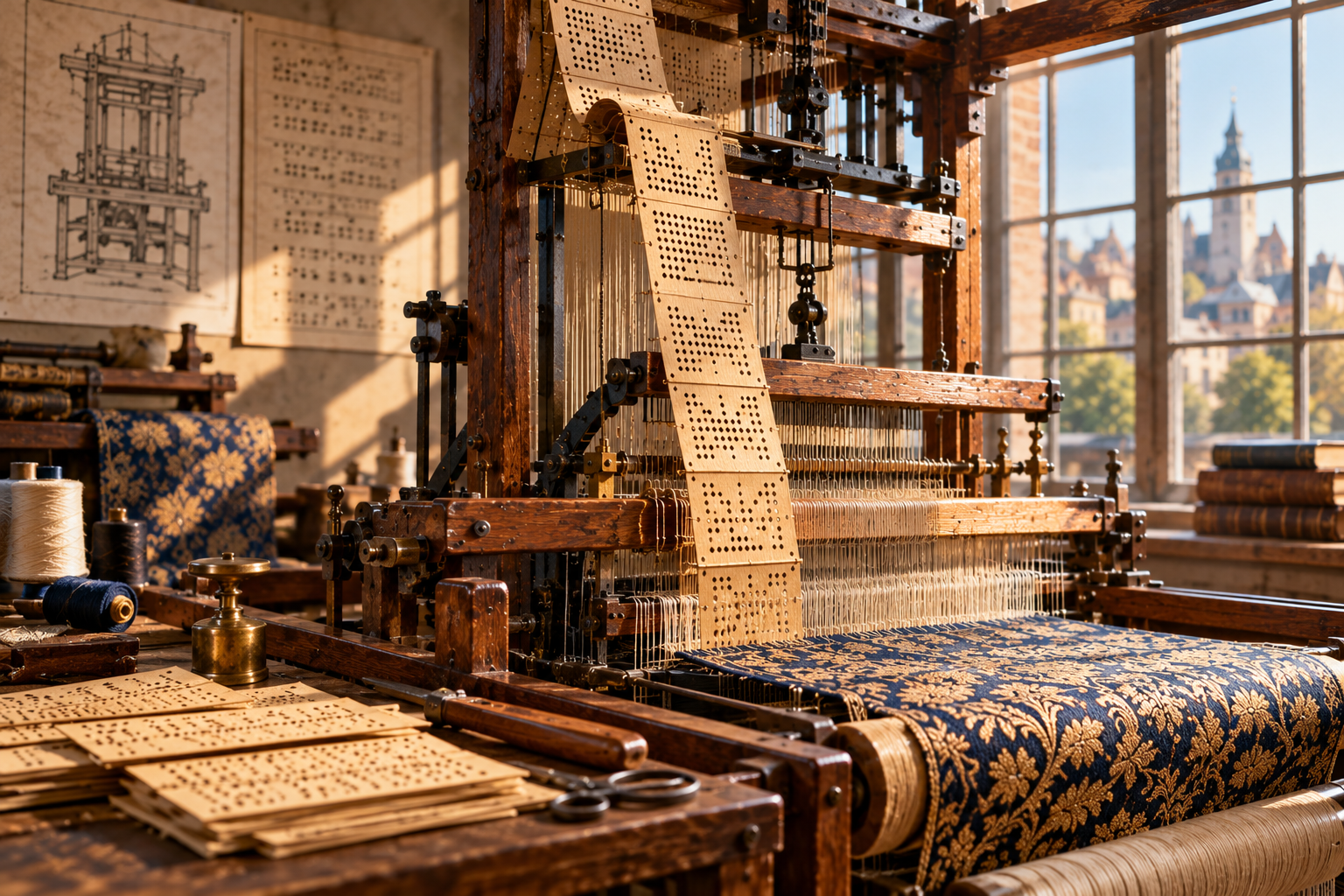
What if one of the ideas behind modern computers began with a machine designed to weave beautiful patterns into fabric? More than 200 years ago, a French inventor helped turn that idea into reality.
In 1801, Joseph Marie Jacquard demonstrated an improved weaving mechanism, and by 1804, his system had been patented. It used specially punched cards to control how threads were lifted, allowing the loom to produce intricate patterns automatically.
How Did the Punched Cards Work?
Each card contained a pattern of holes that told the loom which threads to raise during weaving. The cards were linked together in a sequence, and the machine followed their instructions to create the design. Change the cards, and you could create a different pattern!
From Fabric to Computing
English mathematician Charles Babbage recognized the potential of this idea. In the 1830s, he proposed using punched cards to control operations in his Analytical Engine, a design for a mechanical computer. Later, punched cards were also used to process data, including for the 1890 United States census.
A technology developed to make beautiful fabrics helped inspire a key principle of computing: machines can follow instructions prepared in advance. Sometimes, the story of computers begins not with electricity, but with thread, cardboard, and a clever idea.
Discover more of our wonderful world!
Join us on Telegram for more amazing places, fascinating stories, and incredible facts about our planet.
Follow us on Wonderful World