
Everyone has launched a paper plane at least once. If you throw it high, it glides smoothly and falls. Но if you launch it very low over a flat table, you might notice something strange. Right before landing, the plane seems to hit an invisible barrier and slides through the air for a few more moments, refusing to drop. At that second, it turns into a tiny ekranoplan. Scientists call this the ground effect. This very phenomenon once promised to revolutionize the way we move across the planet.
How America Feared the Ghost of the Caspian
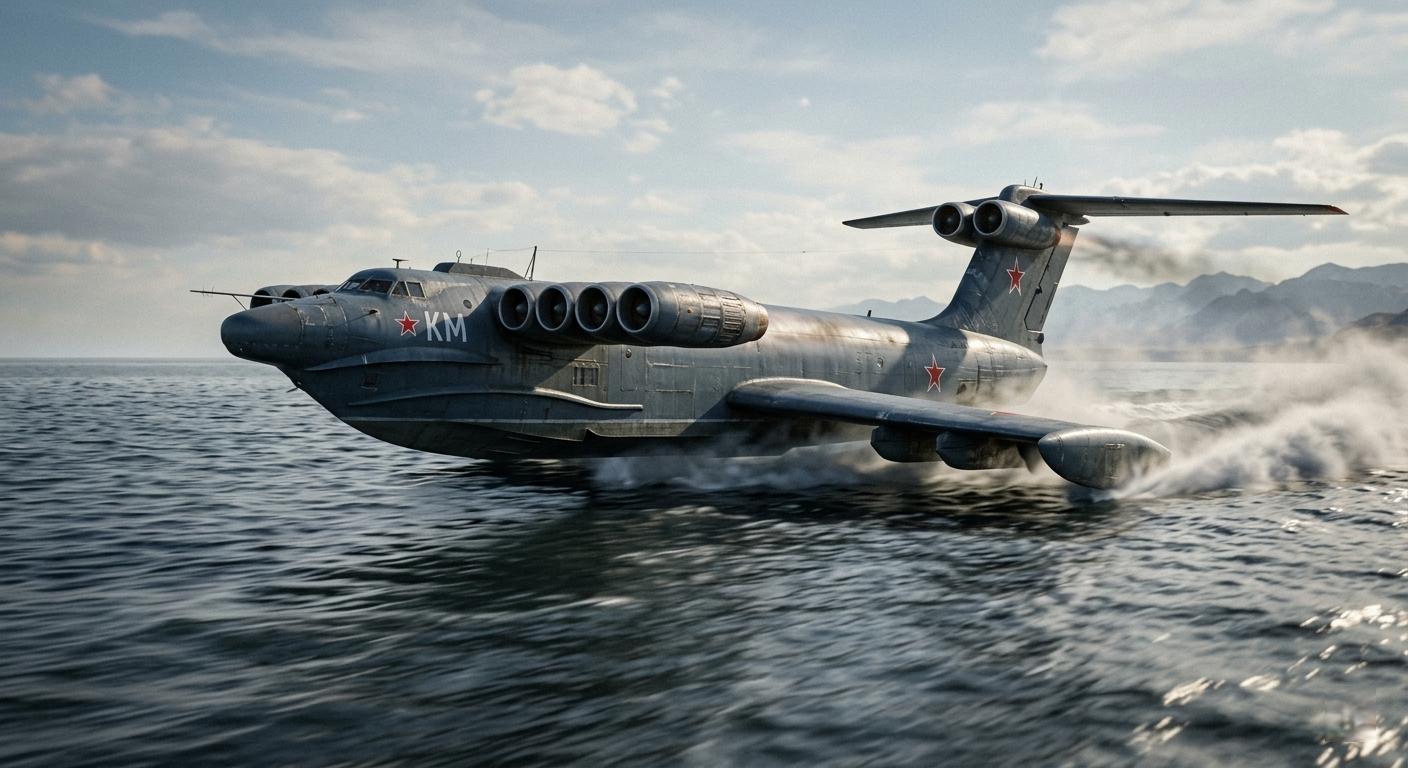
In 1966, American spy satellites captured something incredible over the Caspian Sea. The images showed a gargantuan object 92 meters long with short, wide wings. The letters KM were painted on the nose of this massive machine. Panic erupted at the US Intelligence Agency. Analysts could not figure out what it was. For a ship, it moved too fast, reaching speeds of 500 kilometers per hour. For a plane, it was far too heavy and flew dangerously low, practically touching the water.
The Americans dubbed the find the Caspian Sea Monster. They wondered why the USSR was building such machines. CIA specialists proposed theories about a secret vehicle for sudden troop landings or a high speed carrier for nuclear missiles. In reality, the letters KM stood for Korabl Maket, which means Prototype Ship. It was an experimental model created by designer Rostislav Alexeyev. This man decided to defy the laws of physics and forced a steel box weighing over 500 tons to fly at an altitude of just a few meters.
Mad Numbers and the Power of 10 Engines
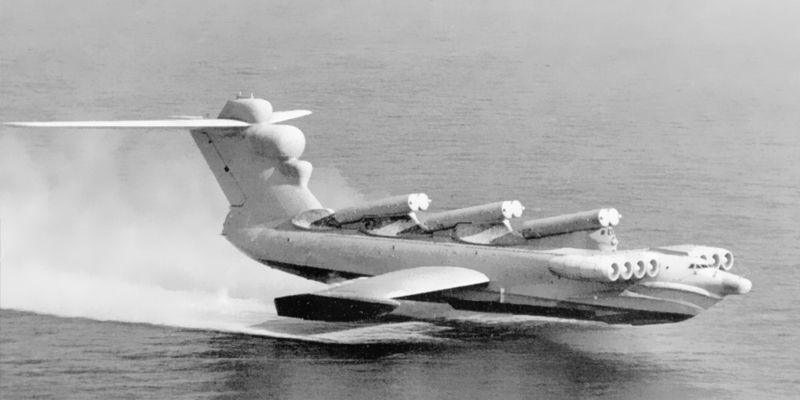
To lift a beast with a maximum takeoff weight of 544 tons into the air, engineers had to take extreme measures. They installed 8 powerful VD 7 jet engines on the nose of the Caspian Sea Monster. These engines forced air under the wings, creating that very dense cushion. Two more identical engines were placed on the tail to provide the main thrust. The total power of this setup was so great that during takeoff, a wall of spray as high as a 10 story building rose behind the vehicle.
The wingspan of this giant was 37.5 meters. Inside the hull, hundreds of soldiers with full gear or several heavy tanks could easily fit. At the same time, the KM could move steadily in sea conditions up to 3 points on the scale. The most striking thing was that the radars of that time practically could not see it. It flew too low for anti aircraft systems and too fast for conventional naval sonars. It was a perfect predator, capable of appearing from nowhere and disappearing over the horizon just as quickly.
Rostislav Alexeyev: A Genius Against the System

Behind every great machine stands a human. Rostislav Alexeyev started by creating hydrofoil ships, which we know as the Raketa and Meteor. But his dream was always flight. He was not just a designer but a true fanatic of his craft. Alexeyev himself often sat at the controls of his prototypes, risking his life to test another idea. Colleagues remembered that he could watch birds over the water for hours, trying to solve their secrets.
However, the path of an innovator in a massive state machine was never easy. Alexeyev constantly faced misunderstanding from officials who did not know which department his invention belonged to. Sailors considered it a bad ship, and aviators called it a misunderstanding that could not rise into the sky. Ultimately, after one of the accidents, Alexeyev was removed from the leadership of his own design bureau. This was a huge blow to a man who literally lived for his flying ships.
Orlyonok: An Attempt to Make the Technology Mass Produced
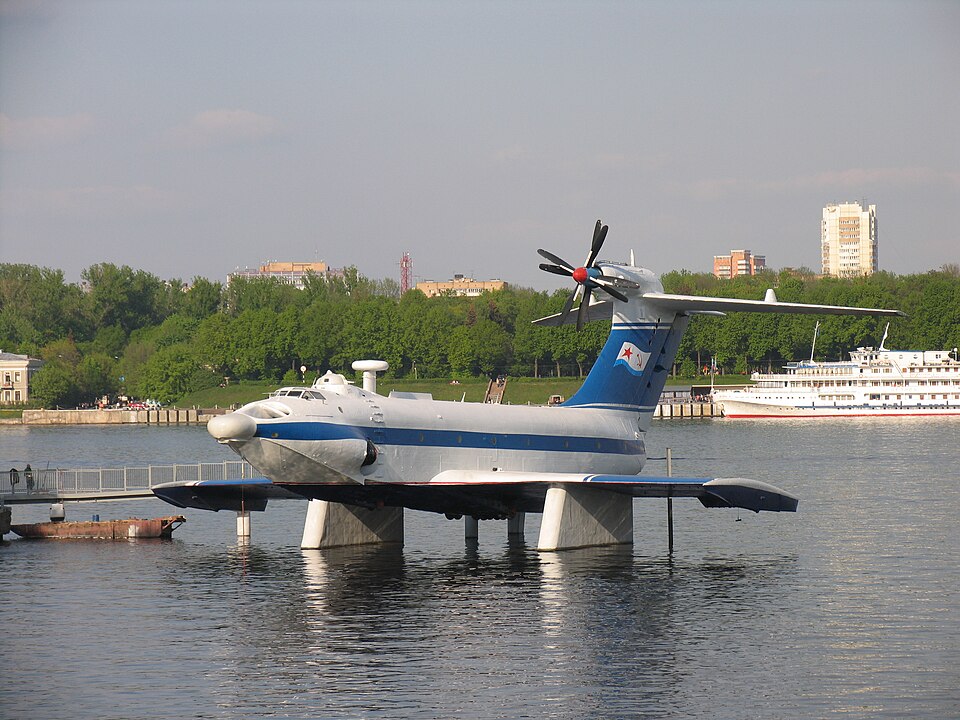
Author: Mike1979, Russia. Own work, CC BY-SA 3.0, https://commons.wikimedia.org/w/index.php?curid=4075446
While the Caspian Sea Monster was a massive laboratory, the Orlyonok project was an attempt to create a workhorse for the military. This ekranoplan was noticeably smaller than its predecessor, with a length of 58 meters. But it was much more practical. The Orlyonok could carry up to 200 marines or 2 armored personnel carriers over a distance of up to 1500 kilometers. In the bow, it had a huge hatch through which equipment could drive straight onto the shore in minutes.
A total of 5 such machines were built. They even managed to serve in the Navy. The Orlyonok had a unique ability to go onto a flat shore and move over snow or ice. This made it an ideal vehicle for northern regions where there are no roads or airfields. Test pilots said the machine behaved surprisingly obediently if the pilot understood the physics of ground effect flight. But even the success of the Orlyonok could not convince the skeptics who considered the technology too exotic and expensive.
Tragedy and the End of the Era of Giants
The story of the world’s largest ekranoplan ended tragically. In 1980, during another test flight, the pilot made a fatal error. During takeoff, he pulled the nose of the machine up too sharply. The massive vehicle lost that invisible air support, rolled sharply to the left, and crashed into the water. Fortunately, the crew managed to escape, but the KM itself was never recovered. It drifted in the sea for a long time, gradually turning into a heap of rusty metal until it finally sank to the bottom.
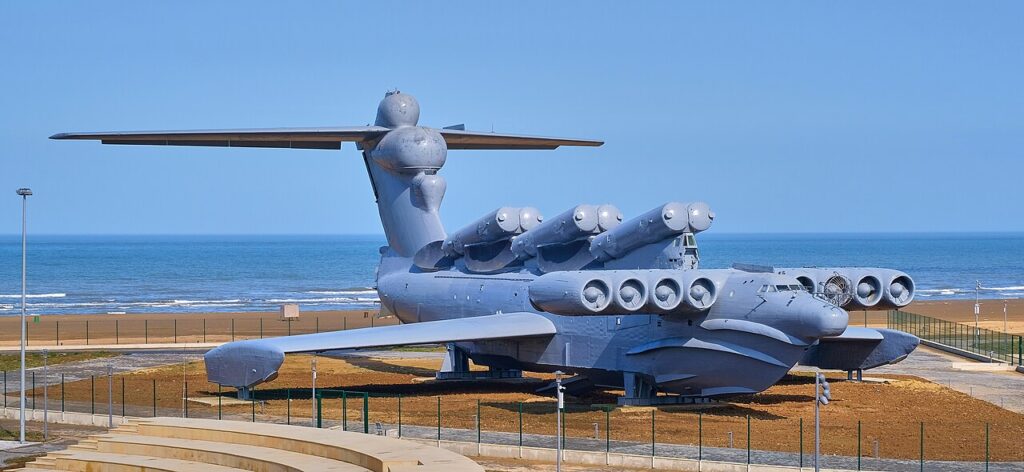
Author: Vyacheslav Bukharov. Собственная работа, CC BY-SA 4.0, https://commons.wikimedia.org/w/index.php?curid=186652503
But the designers were not going to give up. To replace the fallen monster came the Lun project. This was a full scale combat ekranoplan armed with 6 massive Moskit anti ship missiles. Each such missile weighed about 4000 kilograms and could carry a nuclear charge. The Lun was called the carrier killer. One such vehicle was capable of destroying an entire carrier group while remaining practically invulnerable to return fire. However, the collapse of the Soviet Union in 1991 and a chronic lack of money put an end to this ambitious development. Today, the only surviving specimen stands on the shore of the Caspian Sea in Derbent.
Why Flying Ships Never Became Commonplace
Many wonder why we are still not flying on such machines for vacation. The answer lies in the incredible complexity of control and massive expenses. A regular plane forgives many piloting errors because it has a large altitude margin. An ekranoplan has no such margin. Any awkward movement of the controls at a speed of 500 kilometers per hour inevitably leads to disaster. Moreover, sea salt quickly kills delicate aircraft engines, requiring colossal costs for their maintenance.
The problem also was that an ekranoplan needs perfect weather. A strong storm with waves over 3 meters made ground effect flight deadly. The machine would begin to hit the crests of the waves, leading to the destruction of the hull. Engineers tried to solve this problem by installing complex stabilization systems, but this increased the cost of an already expensive machine even further. In the end, military and commercial companies decided to return to time tested solutions.
The Western View: Why They Did Not Succeed
Of course, Western countries did not sit idly by while watching the success of the USSR. In the USA and Germany, they also tried to build ekranoplans, but their projects usually ended at the stage of small prototypes. The main reason was a different approach to engineering tasks. In the West, they tried to make a very low flying plane out of an ekranoplan. Alexeyev, however, created a fundamentally new type of vessel that lives by its own laws.
Furthermore, Western investors were not ready to pump billions of dollars into a technology with an unclear future. The Soviet system allowed for such large scale experiments at the expense of state resources. When that system disappeared, so did the support for massive projects. Interestingly, after the borders opened, many American specialists came to Russia to study Alexeyev’s legacy. They were amazed at how simply and effectively the most complex tasks of controlling multi ton giants were solved.
Technical Heritage and Lessons of History
Creating such objects required not only courage but also entirely new materials. Ordinary aluminum quickly gave up under the impact of waves at a speed of 500 kilometers per hour. Engineers had to develop special alloys capable of withstanding monstrous loads. Every flight was a step into the unknown. Specialists recorded thousands of parameters trying to understand how air behaves in the narrow gap between the wing and the water. This data later became the basis for many modern developments in aviation and shipbuilding.
The ekranoplan project proved that the boundaries of the possible exist only in our heads. A machine weighing 544,000 kilograms was able to rise above the water only thanks to precise calculation and faith in success. And although today these steel giants seem like aliens from another world to us, their story continues to inspire new designers. Ekranoplans remain an important lesson in how one simple idea from a childhood game with a paper plane can turn into a grand project of national scale.
The Future of Flying Ships
Today we are witnessing a second birth of the idea. In different countries around the world, from Singapore to the USA, startups are trying to revive ekranoplans. Now these are not military monsters but elegant electric vessels for transporting passengers between islands. Modern composite materials make hulls light and strong, and artificial intelligence controls the flight much more accurately than any pilot.
Perhaps in 10 or 15 years, a trip from port to port on a flying ship will become as common as a flight on an airplane. This will be the best monument to Rostislav Alexeyev and his team, who were the first to see the potential of the invisible air cushion. We can only wait for the moment when technology and economics finally catch up with the bold dreams of the last century. The history of ekranoplans teaches us that no good idea disappears without a trace. It simply waits for its time to return in a new, even more perfect form.
If you think huge steel machines can only fly high in the clouds check out our story about Hovercraft Dreams – Machines That Lived Between Land and Water. There engineers found another way to tame the air and forced multi ton vessels to ignore the boundaries between the shore and the open sea.
And to find out every day how human genius defies nature and what other incredible monsters are hidden in the history of technology subscribe to our Wonderful Technology channel. There we show a world that never stops amazing us.