
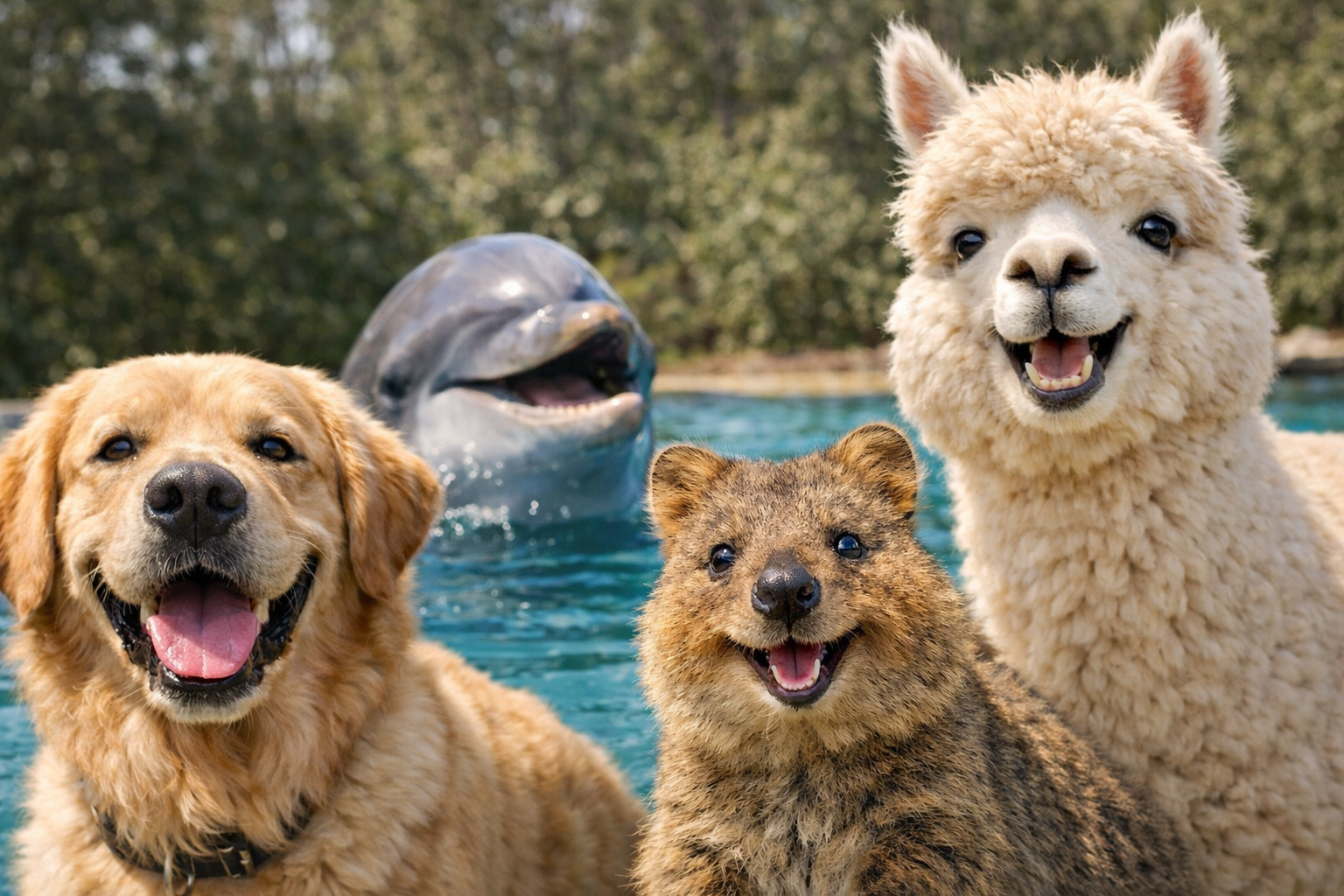
Sometimes it takes just one look. You open a photo and catch yourself thinking something unusual. This animal looks like it is smiling. Not just cute. Not just friendly. Actually smiling, almost like a human expression. And you notice your own reaction right away. You smile back, even if you know it is probably not a real smile in the human sense. The feeling still stays. Warm, direct, and very real.
We react before we analyze. The brain is built for this. It is trained to recognize faces, read expressions, and decide quickly if something is safe or not. That system works fast and usually well. But sometimes it goes further than the facts.
So why do some animals look like they are smiling? Is it just their anatomy. Is it evolution. Or is it the way our brain interprets shapes and patterns. The answer is a mix of all three, and it tells us as much about humans as it does about animals.
Why we see smiles even when they are not there
The human brain is extremely good at turning shapes into faces. Two dark spots become eyes. A line becomes a mouth. If that line curves upward even slightly, the brain reads it as a smile. This happens instantly and without effort.
This process is called anthropomorphism. It means we project human emotions onto animals. It helps us connect and understand faster. But it also means we sometimes add meaning that is not really there.
We are not lying to ourselves on purpose. The brain is just filling gaps using familiar patterns. A curve becomes happiness. A relaxed face becomes friendliness. It feels accurate, even when it is not.
The quokka and the idea of a perfect smile
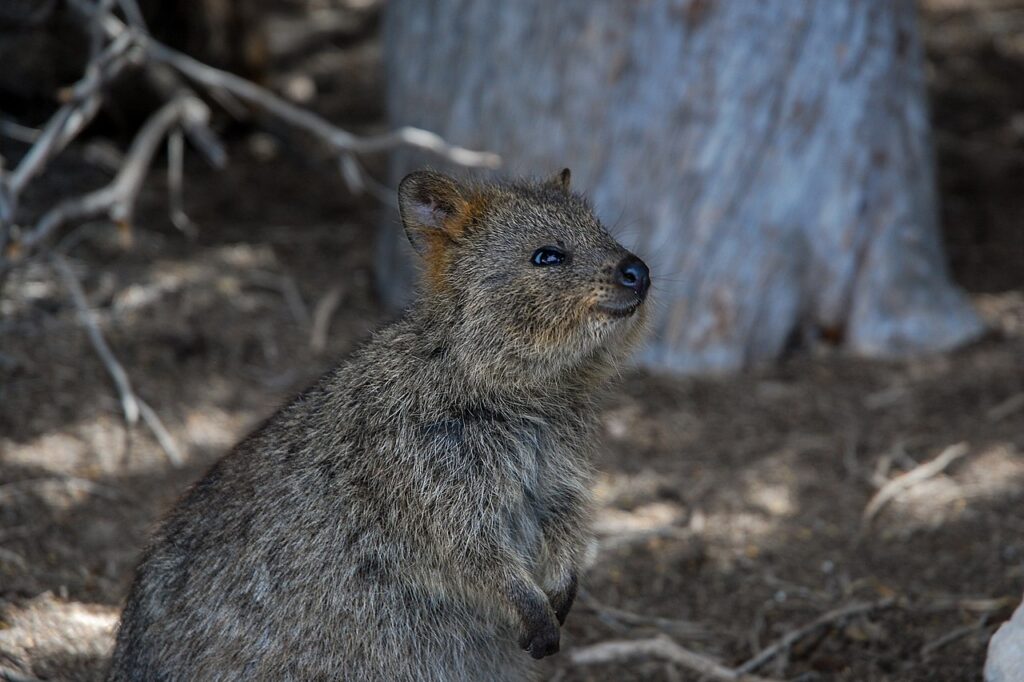
By Ena Music – Own work, CC BY-SA 4.0, https://commons.wikimedia.org/w/index.php?curid=59141601
If there is one animal that represents this idea, it is the quokka. A small marsupial from Australia that became famous around the world because of how it looks in photos.
Its face has a specific structure. The mouth is slightly curved upward. The cheeks are rounded. The eyes appear soft and relaxed. Together, these features create a strong impression of a constant smile.
People travel to see quokkas and take photos with them. The animal is often called the happiest animal on Earth. But this label comes from appearance, not from a confirmed emotional state.
The quokka is not smiling in the human sense. It is not expressing joy through facial muscles the way humans do. This is simply how its face is built. Still, the effect is powerful. Humans respond to it emotionally every time.
Dolphins and the illusion of permanent happiness
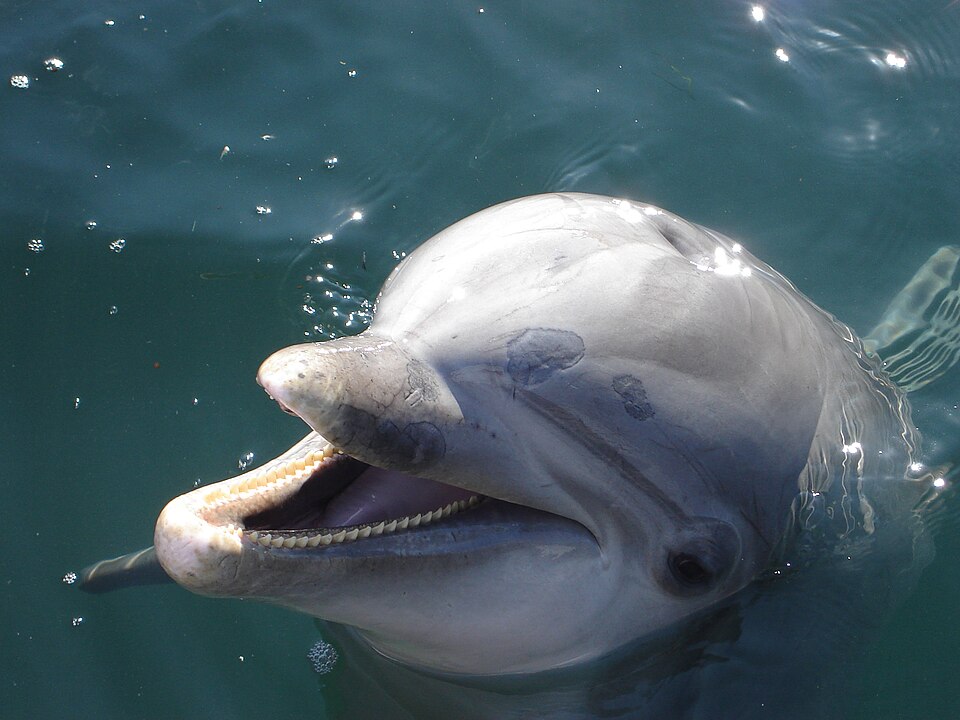
By Flickr user: Ste ElmoreSan Deigo, United Stateshttps://www.flickr.com/people/steelmore/ – Flickr: https://www.flickr.com/photos/63797645@N00/98391847, CC BY 2.0, https://commons.wikimedia.org/w/index.php?curid=22534546
Dolphins create a similar effect. Their jawline naturally curves in a way that looks like a smile. Because of this, people often assume dolphins are always happy or friendly.
This assumption shapes how we see them. Dolphins are used as symbols of intelligence, kindness, and positive energy. But their real behavior is more complex.
They are highly intelligent and social. They communicate, cooperate, and learn. At the same time, they can show aggression and competition. Their facial structure does not reflect their current emotional state.
So the smile we see is not a signal of happiness. It is a fixed physical trait. But it strongly influences human perception.
Dogs, foxes, and expressions that feel real

By Rymcc4 at English Wikipedia – Transferred from en.wikipedia to Commons by Quadell using CommonsHelper., Public Domain, https://commons.wikimedia.org/w/index.php?curid=6916665
With domestic animals, things become more nuanced. Dogs in particular can look like they are smiling, but here behavior plays a role.
When a dog is relaxed, its mouth may be open, the muscles loose, the eyes soft. This combination signals comfort and safety. It is not a human style smile, but it does reflect a positive state.
Humans interpret this as happiness, and in many cases that interpretation is close to reality. The animal is not smiling in a symbolic way, but it is experiencing a calm or positive condition.
Dogs have also evolved alongside humans. They are very good at reading human signals and adjusting their behavior. Eye contact, facial tension, posture, all of this can align in a way that feels expressive and familiar to us.
Why smiling animals go viral
Images of animals that look like they are smiling spread quickly. The reason is simple. They trigger an immediate emotional response.
No explanation is needed. No background is required. The viewer understands the image instantly.
This kind of content works well because it is fast and clear. In a space where attention is limited, simple emotional signals are very effective. A smile suggests safety and friendliness. Even if it is not real, it feels real.
That is enough for people to react, share, and remember.
A small shift in perspective
There is one idea that changes how all of this feels. When we say an animal is smiling, we are describing our interpretation, not its internal state.
We see a familiar pattern and assign it a familiar meaning. That helps us connect, but it can also simplify something more complex.
If we step back, we start to notice differences instead of similarities. The same face can mean different things depending on the species.
Understanding this does not remove the emotional response. It just makes it more accurate.
Final thought
Animals that look like they are smiling are not necessarily experiencing joy the way humans do. Their faces are shaped by function and evolution, not by the need to express emotion in a human format.
But the human reaction is still real. We respond, we connect, we feel something positive.
That moment matters. Not because the animal is smiling, but because we are able to feel a connection, even if it starts from a visual illusion.
If this made you look at animals a little differently, don’t stop here.
Read next: Do Animals Feel Guilt – a question that feels obvious, but isn’t.
And if you enjoy seeing the world this way – a bit deeper, a bit clearer –
join us on Telegram: Wonderful World