
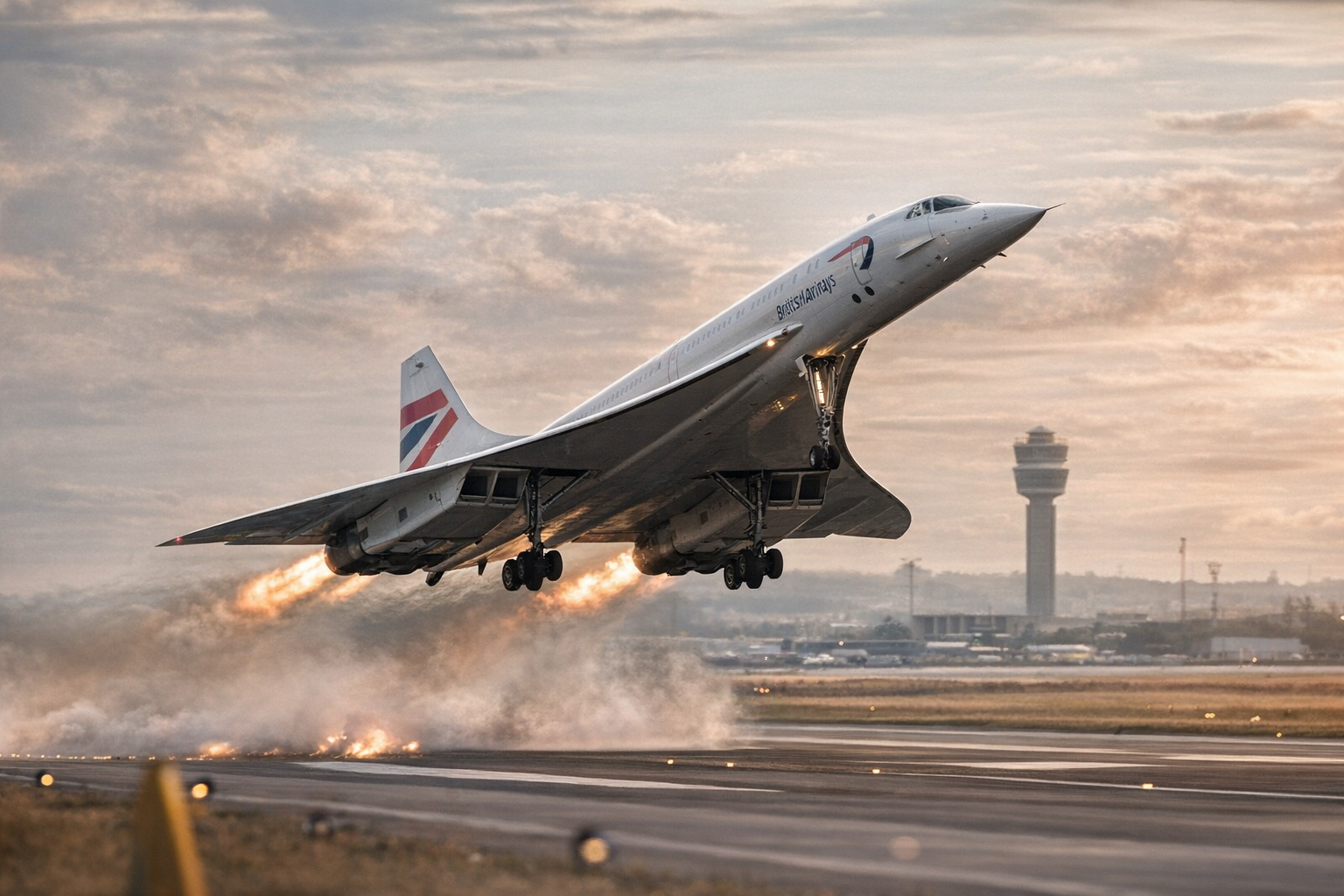
There was a time when the future looked fast.
Not metaphorically. Literally.
In the middle of the 20th century, it felt obvious: if airplanes could already fly, the next step was flying faster than sound. And then even faster. And of course, carrying passengers while doing it – regularly, commercially, just like normal airliners.
Supersonic passenger planes weren’t just transportation. They were a promise. A vision of a world where time would shrink, distances would collapse, and the planet itself would feel smaller.
But here’s the strange part.
Today, we fly slower than we did 50 years ago.
After Concorde, supersonic passenger flights didn’t pause. They didn’t decline.
They vanished.
So what went wrong?
Was it technology? Money? Or fear?
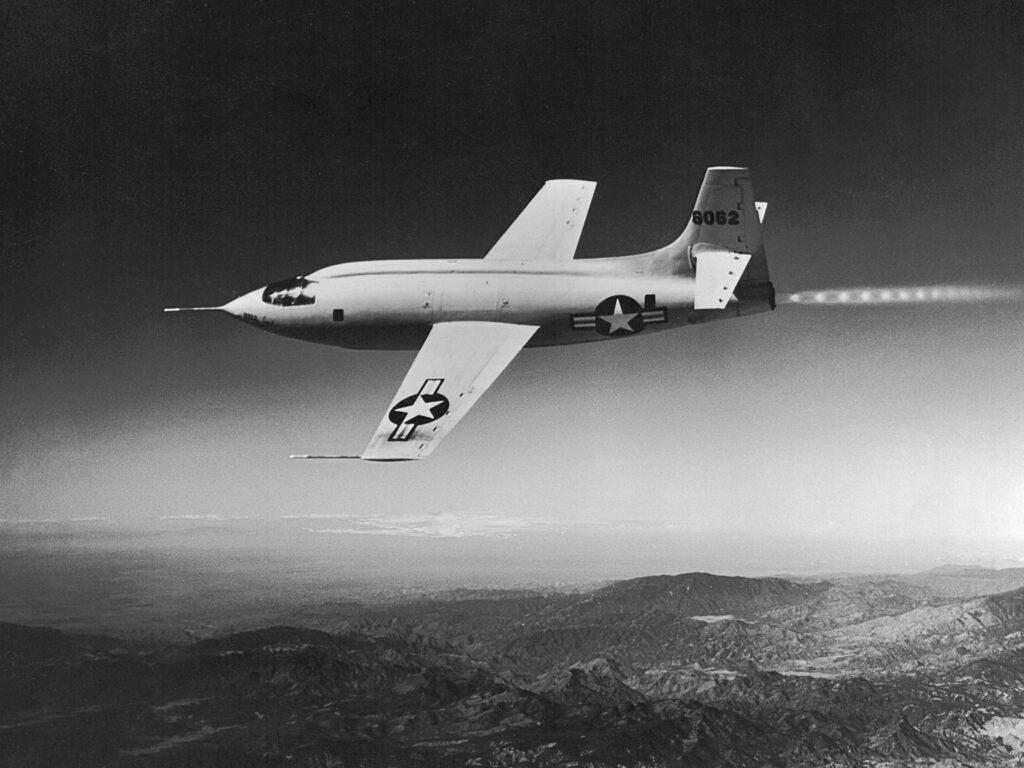
By NASA – NASA Langley Research Center website, Public Domain, https://commons.wikimedia.org/w/index.php?curid=22975326
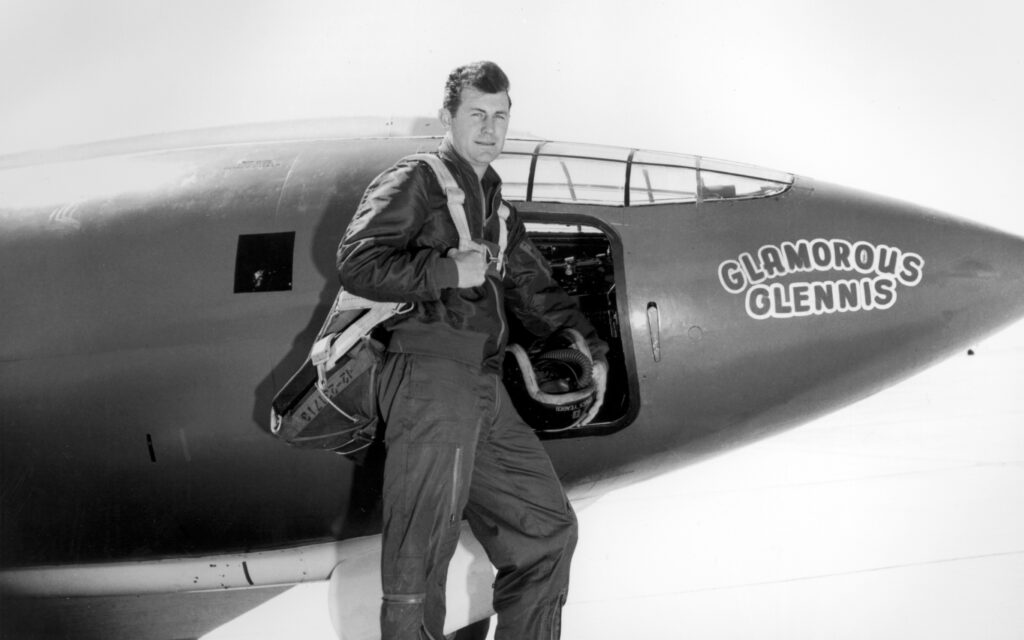
By U.S. Air Force photo – Air Force Link, Public Domain, https://commons.wikimedia.org/w/index.php?curid=1611611
A World That Wanted Speed
After World War II, aviation evolved at a ridiculous pace.
In just a couple of decades, humanity jumped from propeller aircraft to jet fighters capable of breaking the sound barrier.
And when, in 1947, the experimental military aircraft Bell X-1 – piloted by Chuck Yeager – officially flew faster than sound, it wasn’t the end of the experiment.
It was the beginning.
If the military could do it, why not civilian aviation?
By the 1950s and 60s, supersonic passenger flight felt inevitable. Not a question of if – only when.
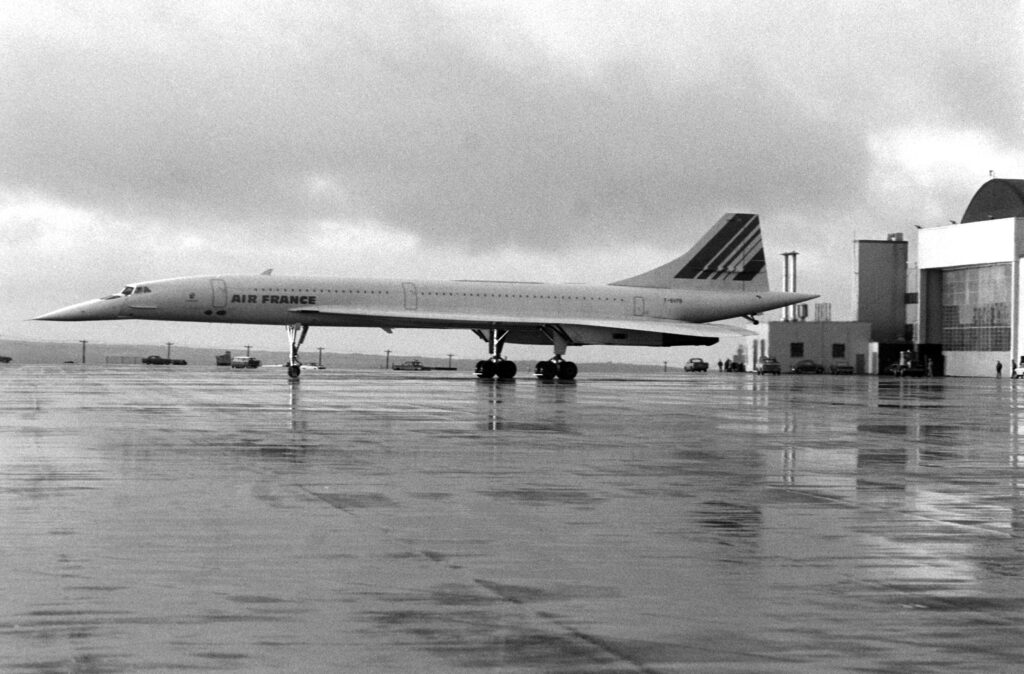
Author: PH3 Caffaro. http://www.dodmedia.osd.mil, Public domain, https://commons.wikimedia.org/w/index.php?curid=2441284
Concorde – The Plane That Was Ahead of Everyone
Concorde wasn’t a concept sketch.
It wasn’t a dream.
It actually flew.
Key Technical Facts About Concorde
- cruising speed: Mach 2.04 (about 2,180 km/h)
- cruising altitude: up to 18,300 meters
- London – New York flight time: around 3.5 hours
- range: roughly 7,200 km
- passenger capacity: 92 – 128 passengers
- engines: 4 Rolls-Royce / Snecma Olympus 593 turbojet engines
- wing design: delta wing
- nose: drooping nose for visibility during takeoff and landing
From 1976 onward, passengers could:
- cross the Atlantic in three and a half hours
- fly above most weather systems
- see the curvature of the Earth
This wasn’t just a flight.
It was an experience.
Concorde became a symbol of:
- technological supremacy
- European engineering cooperation
- absolute belief in progress
But behind the elegance, reality was far less glamorous.
Problem #1 – Economics
Supersonic flight turned out to be expensive.
Painfully expensive.
Concorde:
- burned enormous amounts of fuel
- required highly specialized maintenance
- carried relatively few passengers
Tickets cost several times more than business class.
The people who flew Concorde were usually:
- corporate executives
- politicians
- the ultra-wealthy
It was never meant for the masses.
Problem #2 – Noise
A sonic boom isn’t a figure of speech.
It’s a physical shockwave.
When an aircraft breaks the sound barrier, a loud explosive boom hits the ground.
For cities, that meant:
- shattered windows
- endless complaints
- public fear
As a result, many countries banned supersonic flight over land.
Concorde could only go supersonic over the ocean.
That single rule destroyed most possible routes.
Problem #3 – Environment
In the 1970s, environmental concerns were just beginning to surface.
Even then, it was obvious:
Supersonic aircraft:
- consumed far more fuel
- produced higher emissions
- operated at altitudes that affected the atmosphere differently
Over time, these arguments only became stronger.
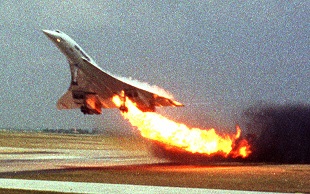
By Toshihiko Sato – Original publication: Unknown (believed to have been licensed to the Associated Press)Immediate source: http://photographyblog.dallasnews.com/2012/07/today-in-photo-history-2000-air-france-concorde-crashes-in-paris.html/, Fair use, https://en.wikipedia.org/w/index.php?curid=48337284
Problem #4 – Fear
Concorde was statistically safe.
But it didn’t feel safe.
A razor-thin fuselage. A sharp nose. Deafening takeoffs. Extreme speeds.
And then came the crash.
On July 25, 2000, Air France Flight 4590 crashed shortly after takeoff in Gonesse, near Paris.
113 people were killed – 100 passengers, 9 crew members, and 4 people on the ground.
The cause was brutally simple:
- a metal strip left on the runway by a previous aircraft
- a tire burst during takeoff
- debris ruptured a fuel tank
- fuel ignited, control was lost
One accident was enough to permanently break public trust.
Why Technology Didn’t Save Supersonic Flight
It’s tempting to say the technology just wasn’t ready.
That’s not entirely true.
Engineers knew how to build supersonic planes.
The real problems were:
- the physics of sound
- fuel economics
- public tolerance for risk
Those aren’t things you can simply engineer away.
Why We Fly Slower Today
Modern aviation is optimized for different priorities:
- fuel efficiency
- comfort
- safety
- scalability
Speed became secondary to ticket price.
The world chose efficiency over velocity.
Will Supersonic Travel Ever Return?
Interest never fully disappeared.
Some companies are experimenting with:
- quieter sonic booms
- new materials
- supersonic business jets
But mass supersonic passenger travel remains unlikely.
Because the biggest barrier isn’t technology.
It’s public acceptance.
One Last Thought
Concorde wasn’t a mistake.
It was a question asked of the future.
The answer turned out to be more complicated than engineers expected.
Sometimes progress isn’t about going faster.
It’s about understanding when speed stops being an advantage.
👉 Want to continue learning? Read our article on Autogyros: The Forgotten Cousins of Helicopters
📡 Follow us on Telegram – Wonderful Technology