
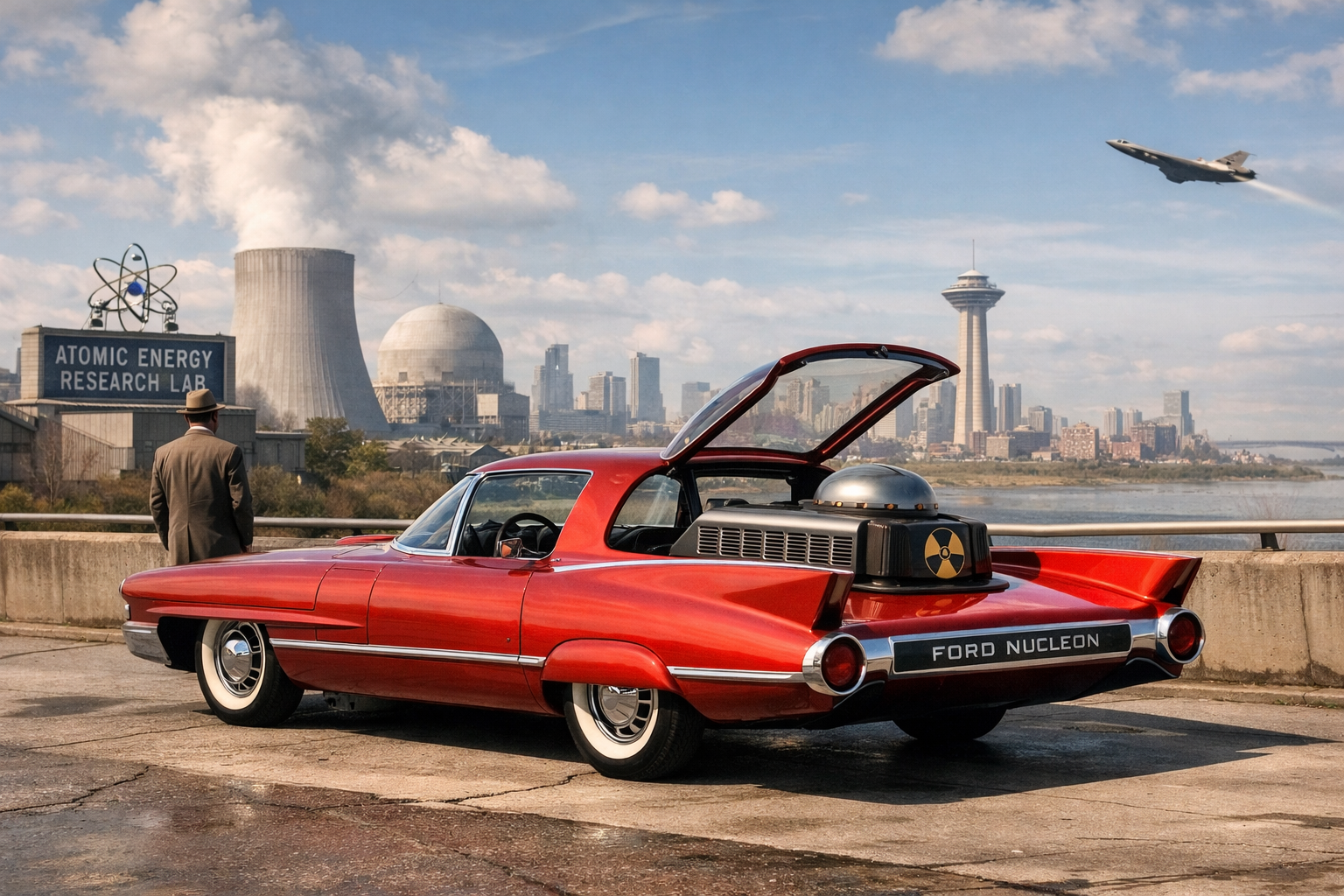
Some ideas sound crazy today. Like, completely unhinged.
But if you rewind history and land in the right decade, those same ideas suddenly make perfect sense. Nuclear-powered cars are one of them.
Back in the 1950s and 60s, engineers, designers, and futurists seriously believed that cars wouldn’t need gasoline anymore. No gas stations. No exhaust pipes. No oil dependence. Just one tiny nuclear reactor and your car could keep driving for years.
Yeah, it sounds like sci-fi now. Almost like a joke.
But back then? It felt like the next logical step. Humanity had already split the atom. Nuclear submarines were cruising underwater for months. Energy seemed limitless. If the atom could move a war machine, why couldn’t it move a family car?
And yet, not a single nuclear car ever hit public roads.
The idea didn’t fail because engineers were dumb. It failed because reality hit harder than optimism.
This is the story of nuclear cars – why the atom looked like the perfect fuel, what engineers actually designed, and why the whole idea was doomed from day one.
A World Obsessed with the Atom
After World War II, the atom became the symbol of the future.
It was terrifying. But it was also irresistible.
Nuclear energy promised everything at once:
- insane amounts of power
- cheap electricity
- freedom from natural resources
- total technological dominance
In the US, Europe, and the Soviet Union, nuclear tech was everywhere. Power plants. Military fleets. Research labs. Pop culture.
Ads talked about “atomic homes.” Magazines showed “atomic cities.” Even kids’ toys had radiation symbols slapped on them. The word nuclear sounded magical.
And cars – the ultimate symbol of freedom in the 20th century – couldn’t stay out of this dream.
If a nuclear reactor could push a submarine through the ocean, why not a car down the highway?
Why the Idea Looked Brilliant
From an engineer’s point of view in the mid – 20th century, a nuclear car almost looked perfect.
Almost Infinite Range
A normal car could go maybe 300 – 500 kilometers on a full tank.
A nuclear car? In theory, tens of thousands of kilometers without refueling.
Some concepts promised:
- one fuel core lasting 5 – 10 years
- no gas stations at all
- barely any maintenance
For the age of endless highways, that sounded like a dream.
No Exhaust, No Smoke
A nuclear reactor doesn’t burn fuel like an engine does.
So technically:
- no exhaust gases
- no CO₂
- no black smoke
Long before anyone seriously talked about climate change, nuclear cars already looked “clean.”
Goodbye, Oil
Cold War politics, oil dependence, future shortages – all of that was already on people’s minds.
A car that didn’t need gasoline meant freedom:
- for governments
- for the military
- for everyday drivers
Pure Tech Flex
A nuclear car wouldn’t just be transportation.
It would be a statement.
“We’re so advanced, we drive on atoms.”
In the 1950s, that mattered.
How a Nuclear Car Was Supposed to Work
To be clear: nobody planned to stick a full-size power plant under the hood.
The idea was a compact nuclear reactor that:
- produced heat from atomic fission
- converted that heat into energy
- powered the wheels through turbines or generators
Basically, a tiny nuclear power station on wheels.
The reactor itself had to be:
- fully sealed
- extremely durable
- maintenance-free
Sounds complicated?
It was.
Real Projects, Not Just Drawings
This part surprises a lot of people.
Nuclear cars weren’t just fantasy sketches. Real companies explored them.
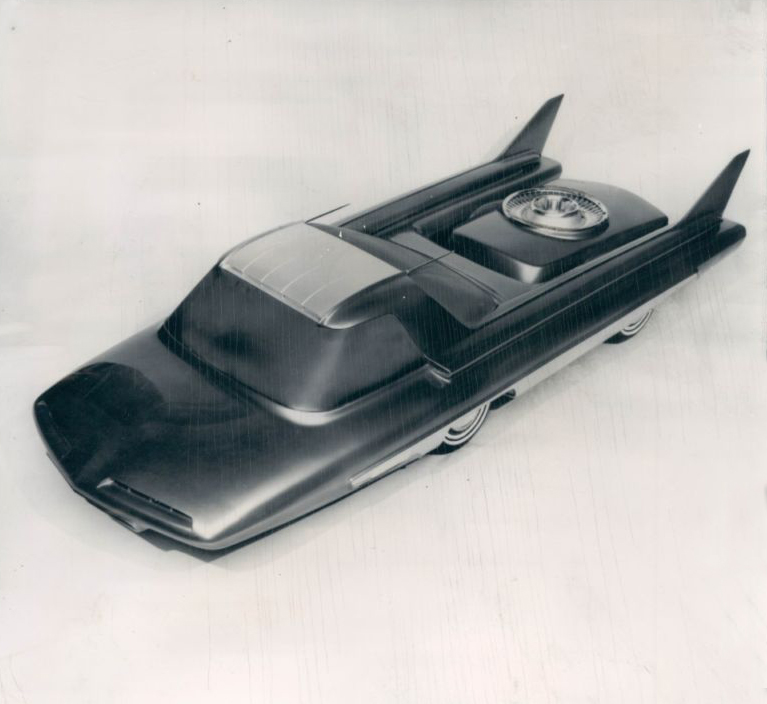
By Unknown author – https://classiccars.fandom.com/wiki/Ford_Nucleon, Public Domain, https://commons.wikimedia.org/w/index.php?curid=106707795
Ford Nucleon
The most famous example.
In 1958, Ford revealed the Ford Nucleon – a concept car designed to run on nuclear power.
What made it wild:
- the reactor sat in the back
- no gas tank at all
- pure space-age design
Ford openly admitted it wasn’t a working prototype. It was a vision. But a vision meant to be taken seriously.
And Others Too
During the 50s and 60s, dozens of nuclear vehicle ideas appeared:
- nuclear trucks
- atomic buses
- military transport vehicles
Some engineers even pitched nuclear trains and airplanes.
It was an era where the limits of “possible” felt blurry.
Problem #1 – Radiation Shielding
This is where things started falling apart.
A nuclear reactor isn’t just an energy source.
It’s radiation.
To protect passengers, you’d need shielding made of:
- lead
- concrete
- heavy alloys
Even the lightest protection would weigh:
- hundreds of kilos
- more likely, several tons
The car would turn into a rolling bunker.
And that was just on paper.
Problem #2 – Crashes
Cars crash.
Even when driven carefully.
Now imagine:
- a collision
- a rollover
- a fire
And there’s a nuclear reactor inside.
Even minor damage to the reactor casing could mean:
- radioactive contamination
- evacuating entire areas
- long-term consequences
One accident could become a disaster.
No insurance company would touch that.
Problem #3 – The Price Tag
Nuclear reactors are expensive.
Very expensive.
Even a simplified version would cost:
- as much as dozens of regular cars
- plus safety systems
- plus specialized servicing
A nuclear car was never going to be mass-market.
At best, it would be a toy for elites or the military.
Problem #4 – Maintenance and Disposal
Fast forward ten years.
What now?
The reactor:
- degrades
- becomes nuclear waste
- needs special disposal
Where do you replace it?
At your local garage?
Exactly.
The Moment the Dream Died
By the 1960s, the conclusion was obvious:
- nuclear cars were too dangerous
- too heavy
- too expensive
Meanwhile, other technologies kept improving:
- combustion engines
- electric motors
- alternative fuels
Public perception of nuclear power also shifted.
After accidents and nuclear tests, the atom stopped feeling like a utopia and started feeling like a threat.
The idea didn’t get banned.
It didn’t cause scandals.
It just quietly disappeared.
Why We Still Talk About Nuclear Cars
Because they’re a lesson.
They show how:
- technology can outrun common sense
- optimism can blind even smart engineers
- not every powerful idea belongs in everyday life
Sometimes the real question isn’t “Can we do it?”
It’s “Should we?”
One Last Thought
The idea of nuclear cars was beautiful.
Bold.
Strangely logical for its time.
But roads aren’t laboratories. And daily life isn’t an experiment.
Sometimes progress isn’t about pushing forward at all costs – it’s about knowing when to stop.
And maybe that’s exactly why nuclear cars stayed where they belong: in blueprints, museums, and dreams of a future that never came.
👉 Want to continue learning? Read our article on Shilovsky’s First Two-Wheeled Gyroscopic Vehicle
📡 Follow us on Telegram – Wonderful Technology