

Imagine a place where bridges aren’t built – they’re grown. Not in a year, not in five, but over decades. A place where crossing a raging river doesn’t depend on concrete or steel, but on patience, instinct, and the ability of humans to cooperate with living roots. Sounds like fantasy, right? But nope – this is real. This is Meghalaya, a state in Northeast India known as the “abode of clouds,” a land soaked in mist, waterfalls, and monsoon rains so wild they rewrite the landscape.
And right there, in this rain‑soaked world, you’ll find the living root bridges – structures that look like nature decided to try architecture and absolutely nailed it.
But to appreciate their magic, you’ve got to know their story. Not just how they grow, but why they exist at all – the real history, the legends of the Khasi people, and the kind of wisdom you only pick up when you’ve lived in perfect sync with the forest for hundreds of years.
Where it all begins – a land where rain writes the rules
Meghalaya isn’t just rainy. It’s one of the wettest places on Earth. Cherrapunji and Mawsynram get up to 11 – 12 meters of rainfall a year. Not inches. Not centimeters. METERS.
Rivers here don’t gently flow – they explode into existence. One night you have a trail, the next morning it’s a raging stream. Waterfalls appear out of nowhere. Landslides reshape entire valleys.
For the Khasi and Jaintia people, who’ve lived here for centuries, the biggest challenge was simple:
How do you cross rivers that don’t stay the same for even a week?
Wooden bridges? Rot in a couple of seasons. Bamboo bridges? Gone even faster. Stone bridges? Need tools and engineering resources that didn’t exist.
But the forest had already solved the problem.
The giant Ficus elastica – the rubber fig – grows roots that cling like iron, stretch like rope, and get stronger the wetter it gets. Someone, generations ago, looked at those roots and thought:
“What if we could guide them?”
Their name is lost, but their idea survived.
Legends from Meghalaya – how the forest “helped” the people
Khasi elders tell stories that the first bridges weren’t made by humans at all.
One legend says the spirit of the forest stretched the roots across the rivers when the rains became too violent for the villages to stay connected.
Another tells of a landslide that separated a family from their village. The elders prayed, and the ficus “heard” them, sending its roots across the gap.
These are myths, sure – but they show the mindset. The Khasis never tried to dominate the forest. They treated it as a partner.
And honestly? That worldview explains why these bridges exist at all.
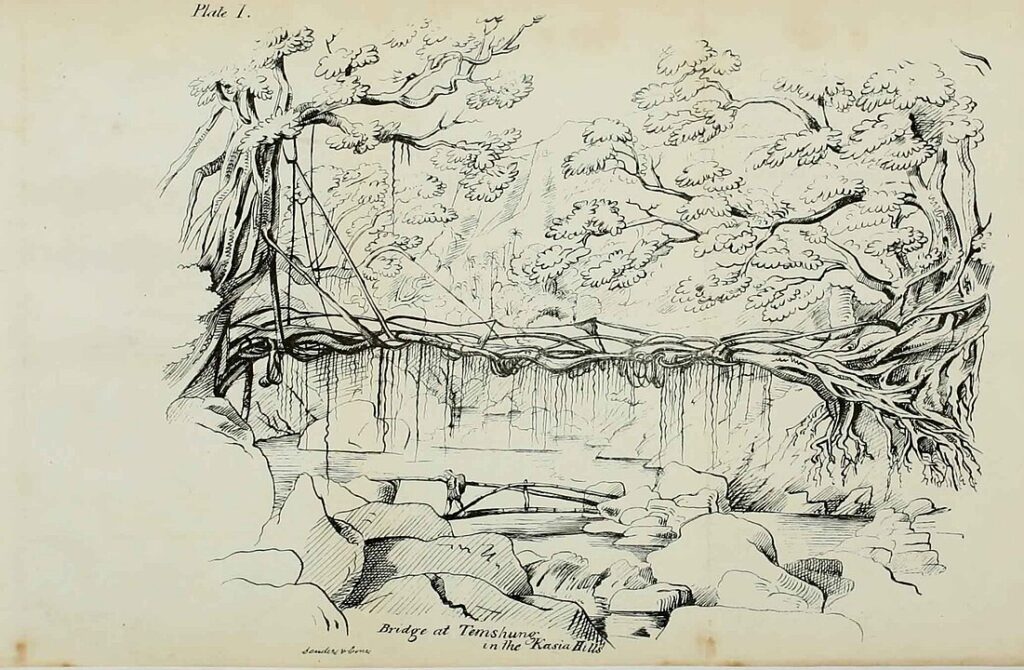
By Henry Yule – https://www.biodiversitylibrary.org/page/40125685, Public Domain, https://commons.wikimedia.org/w/index.php?curid=175460642
Europeans stumble upon the bridges and absolutely lose their minds
By the mid‑1800s, British officers exploring Northeast India began documenting these living structures. One 1844 report describes:
“A bridge not constructed by hand yet directed by man, the strongest in the region.”
They couldn’t wrap their heads around it:
- a bridge that self-repairs,
- becomes stronger with age,
- can be 150 – 200 years old,
- and is made entirely of living roots.
For them, it was basically sorcery with botany.
How a living root bridge grows – nature’s engineering masterclass
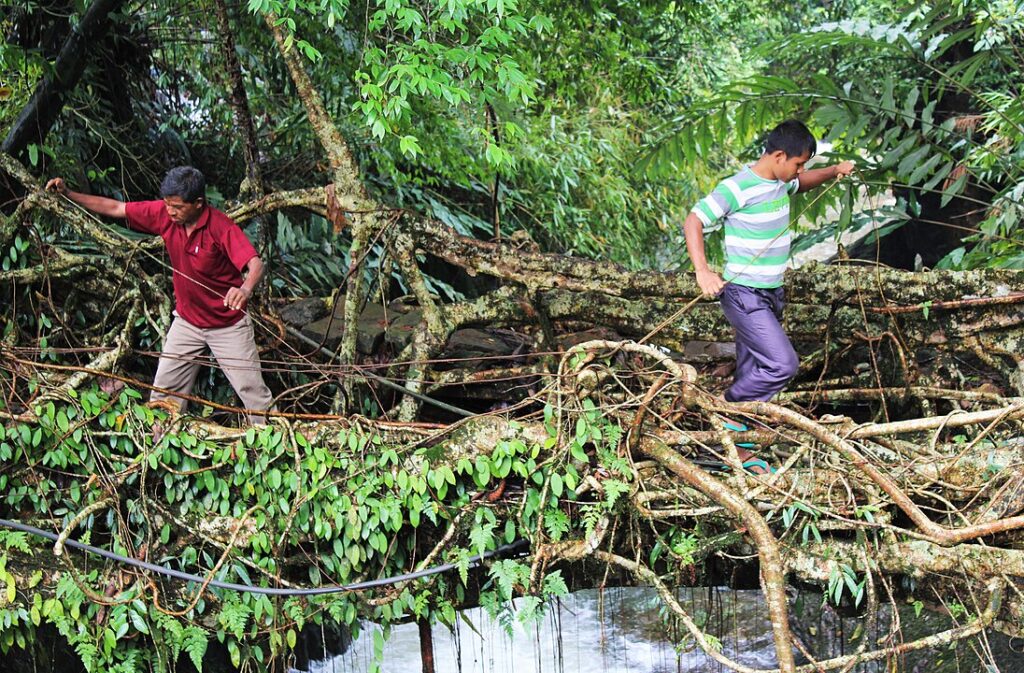
By Elbowmacaroni – Own work, CC BY-SA 4.0, https://commons.wikimedia.org/w/index.php?curid=62182423
The process is simple in theory, tricky in practice, and genius in the way it uses biology instead of brute force.
Here’s how Khasi and Jaintia families do it:
- A Ficus elastica tree must grow near the river.
- Young aerial roots are gently guided across the river using bamboo channels or hollowed areca palm trunks.
- The root keeps growing until it reaches the opposite bank.
- Once it anchors into soil or stone, strengthening begins – weaving, adding new roots, thickening the structure.
- After 10 – 15 years, you get a thin, usable walkway.
- After 30 – 40 years, the bridge can carry groups of people.
- After 70 – 100 years, it becomes a full-scale, rock-solid crossing.
And it doesn’t stop there – the bridge keeps growing, adapting, reacting to weight and seasons like a living creature.
The most iconic root bridges of Meghalaya
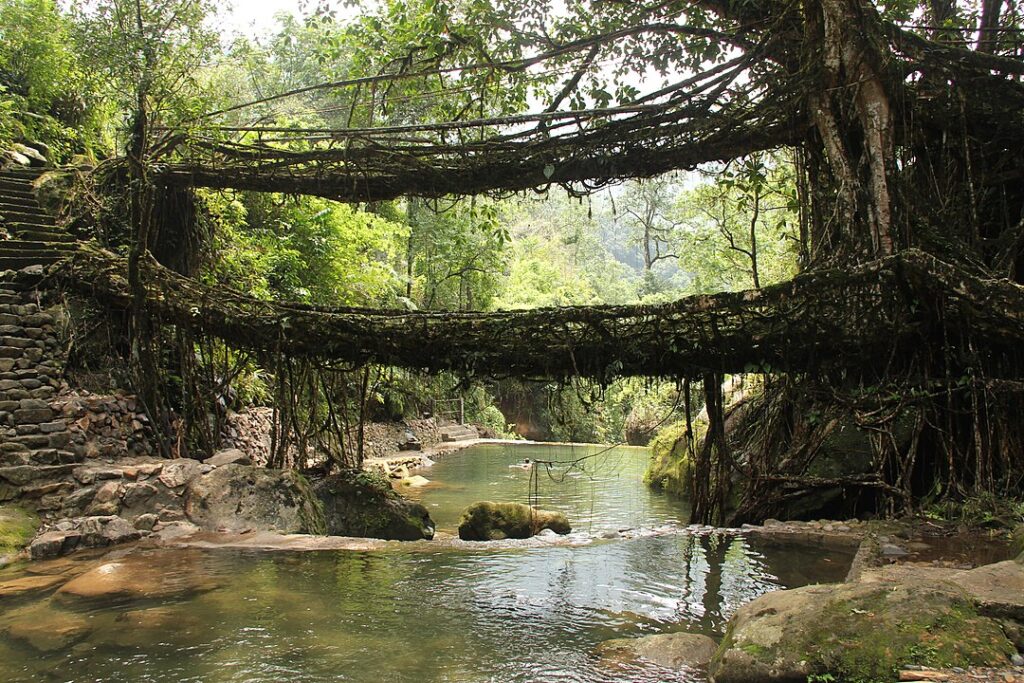
By Arshiya Urveeja Bose – Flickr, CC BY 2.0, https://commons.wikimedia.org/w/index.php?curid=17238490
The Double-Decker Root Bridge of Nongriat
An absolute icon. The lower level might be over 150 years old. The upper level was grown later – a two‑story living bridge, the only one of its kind.
Mawlynnong root bridges
Located near the “cleanest village in Asia,” these bridges look like they were woven by the rainforest itself.
The Seven Sisters & Riwai bridges
Networks of ancient living bridges that connect forest trails. Some are so old that nobody remembers who started them.
Facts you can drop into any conversation
- A strong root bridge can support up to 50 people at once.
- The longest living bridge reaches about 30 meters.
- They’re built using zero nails, zero concrete, zero metal.
- Root bridges often survive floods that destroy steel structures.
- New roots can be woven in at any time – the bridge simply absorbs them.
- Khasis treat bridges not as objects, but as living beings.
Why root bridges work so well – the secret of Ficus elastica
Ficus elastica isn’t just a tree. It’s a biomechanical beast.
Its roots:
- grow in extreme humidity,
- resist rot,
- handle massive tension and weight,
- fuse with other roots into natural “reinforced frameworks,”
- thicken exactly where the bridge experiences the most stress.
Basically nature invented organic engineering long before humans did.
What these bridges really mean to the Khasi people
For the Khasis, a root bridge is not a project – it’s a legacy.
A person who starts a bridge knows they won’t see it finished. It’s built for their children. And their children’s children.
It’s architecture with a long attention span. It’s infrastructure shaped by patience rather than urgency.
In a world where everyone wants everything right now, the idea of building something for 50 – 100 years in the future feels almost rebellious.
Conclusion
The living root bridges of Meghalaya aren’t just practical solutions to monsoon chaos. They’re proof that humans and nature can work together without fighting.
They don’t break. They don’t age out. They don’t pollute. They simply grow.
Maybe that’s why standing on one feels different. You’re not walking over something humans forced into place. You’re walking over a partnership – a slow, patient collaboration between a tree, a community, and time itself.