
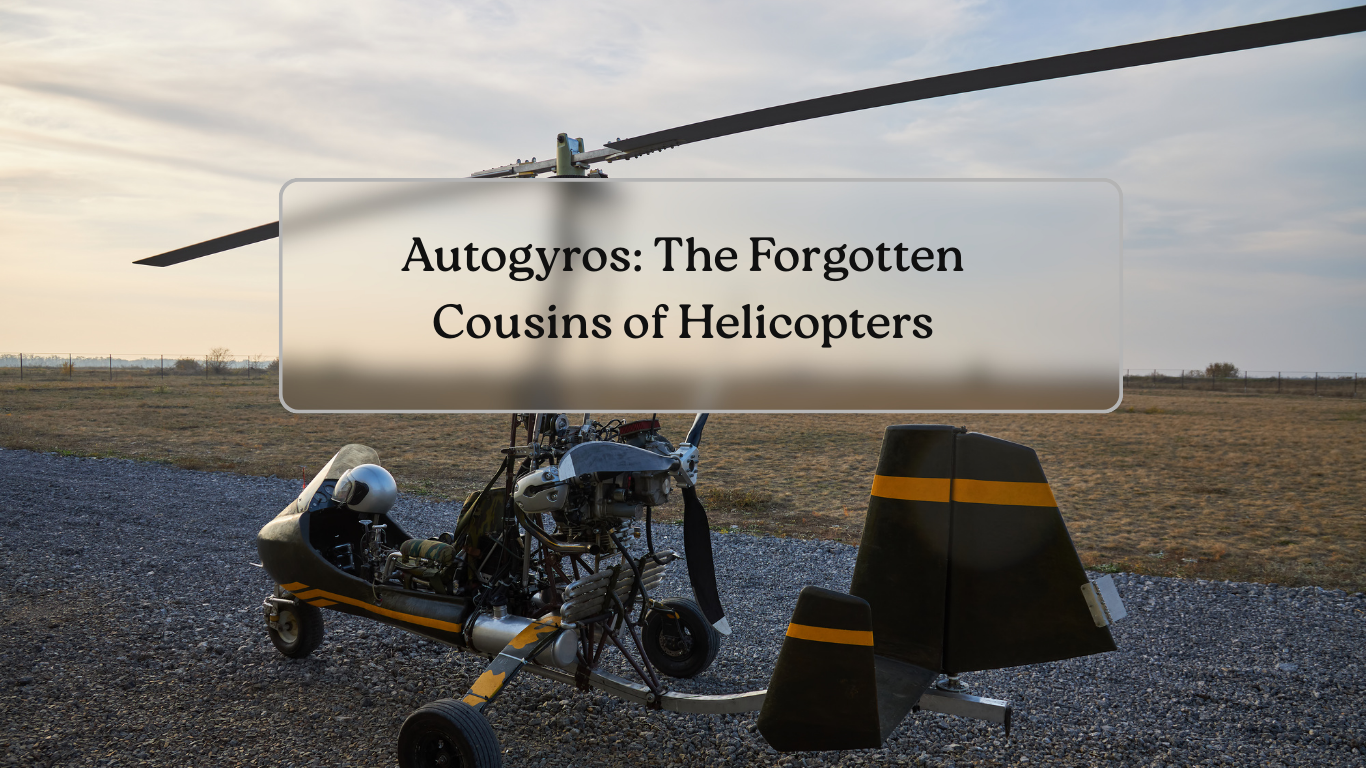
They don’t rush. They don’t roar. They spin in a calm, steady rhythm that feels almost old‑fashioned, as if these machines were born in a quieter era of aviation. Autogyros – those curious aircraft with a freely turning rotor on top and a pushing propeller behind – once carried the hope of becoming the future of short‑distance flight. For a moment, they really seemed like the perfect middle ground between airplanes and helicopters.
And yet… history set them aside. Not erased, but tucked away. Almost forgotten.
What an autogyro really is
An autogyro looks a little like a helicopter at first glance, but it works very differently. Its rotor isn’t powered by the engine. Instead, it spins freely as air passes upward through the blades. This phenomenon – autorotation – creates lift. The engine drives only the rear propeller, which pushes the aircraft forward.
It’s a beautifully simple concept. The forward motion creates airflow. The airflow turns the rotor. The rotor produces lift. As long as the autogyro keeps some forward speed, the rotor keeps spinning and the aircraft stays comfortably in the air.
There’s something interesting here: because the rotor is always in autorotation, the aircraft can’t stall in the traditional sense. Even if the engine quits, the rotor keeps turning, letting the autogyro glide safely down. Pilots often describe this as a feeling of calm – the machine works with the air, not against it.
The Spanish engineer who changed everything
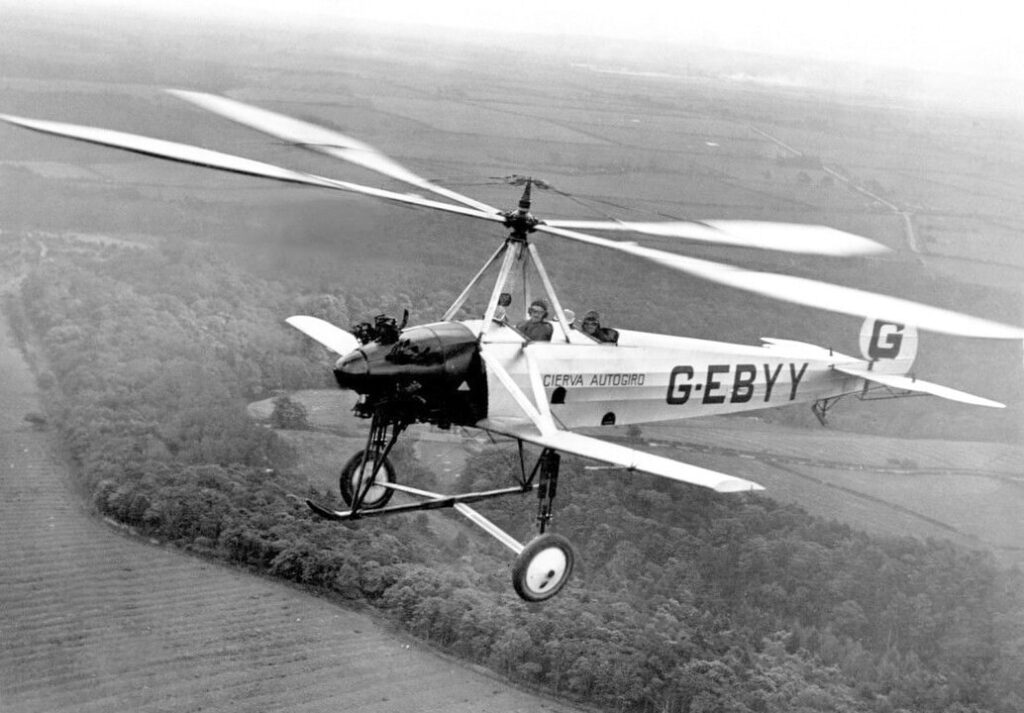
Author: Le Document aéronautique. https://gallica.bnf.fr/ark:/12148/bpt6k9767758z/f741.item, Public domain, https://commons.wikimedia.org/w/index.php?curid=73401107
To understand how autogyros appeared, we go back to the early 1920s. Airplanes were becoming faster, but still suffered from dangerous stalls at low speeds. Many accidents happened simply because wings lost lift during takeoff or landing.
Spanish engineer Juan de la Cierva thought a lot about this problem. He believed that flight could be safer if the lifting surface behaved differently – if it couldn’t stall at all. His solution was the first practical autogyro. In 1923, his rotor design took to the air and proved something revolutionary: autorotation could keep an aircraft flying even at very low speeds.
The idea spread quickly. Cierva’s autogyros attracted attention in Europe, the United States, and beyond. Engineers felt they had stumbled upon something that might redefine aviation.
The era of experiments and optimism
By the 1930s, autogyros became a symbol of innovation. They appeared at airshows, flew demonstration routes across cities, and even carried mail in the United States. The Pitcairn Company, working under Cierva’s license, built autogyros for short‑range postal flights. In Britain, they served in early military training programs. Their ability to take off and land in short distances impressed everyone.
Several countries experimented with their own designs. Some were elegant, some crude, but all carried the same spirit: a search for safe, accessible flight.
Pilots loved these machines. They felt forgiving, predictable, almost gentle. In a time when airplanes were still temperamental, autogyros offered relief. You didn’t have to fight them – you simply guided them.
Why helicopters took the spotlight
But aviation kept evolving. Engineers eventually learned how to power a rotor directly. This opened the door to vertical flight – true hovering, vertical takeoff, the ability to rise straight up and move in any direction. For military and rescue operations, that capability was priceless.
Helicopters demanded more complex engineering, but their advantages were too significant. By the mid‑1940s, autogyros were overshadowed, and production declined sharply.
Still, they didn’t disappear.
A quiet second life
While helicopters conquered commercial and military roles, autogyros found a home in small aviation communities. Enthusiasts loved them for their simplicity and safety. Homebuilt models appeared. Light, playful designs took shape. People used them for sightseeing, hobby flying, aerial photography.
And today, surprisingly, interest is returning. Modern autogyros feature composite materials, aerodynamic cabins, digital instruments, and reliable engines. Yet the heart of the design – autorotation – remains unchanged. The air still spins the rotor. The machine still flies with a kind of humble elegance.
Many pilots consider autogyros among the safest light aircraft ever created. Even a complete engine failure rarely becomes a crisis. The rotor keeps turning, and the aircraft settles gently to the ground.
A symbol of a different attitude toward flight
There’s something philosophical about autogyros. They aren’t about speed or power. They aren’t trying to dominate the sky. Instead, they embrace a softer idea of flying – one that works with natural airflow rather than conquering it.
Flying an autogyro feels almost like gliding with assistance. You sense the air more directly, feel how the rotor responds, how each gust becomes part of the motion. Many pilots say that this is why autogyros attract romantics – people who love the sky not for records, but for the experience itself.
Looking back and ahead
Autogyros may not have become the world’s primary aircraft, but their story isn’t a failure. It’s a reminder that aviation grew not only through dramatic breakthroughs, but also through quiet, elegant ideas. The autogyro solved problems its era struggled with. It proved that autorotation could keep pilots safe. And it influenced helicopter design more than most people realize.
Today, when you watch an autogyro rise gracefully into the air, you sense a connection between past and present. The technology is old, yet still fresh. Still inspiring. Still whispering that even forgotten paths in aviation can lead to beautiful places.
And maybe that’s the charm of autogyros – they invite us to slow down, breathe, and remember that flying can be simple, honest, and deeply human.
👉 Continue exploring:
Solar Aircraft – Planes That Don’t Need Fuel
And if you enjoy stories about unusual and inspiring technologies, you’ll find even more in our Telegram channel Wonderful Technology.